What is a manufacturing ERP?
A manufacturing ERP is software that runs a factory's core records in one database: stock, bills of materials, work orders, purchasing, job costs,…
manufacturing ERP54 answers, written plainly for owners and managers of 10 to 50 person shops: what the terms mean, which system fits, what it costs and how to run stock, jobs, costing and quality. Vendor-neutral, with one honest section on where ZMOS fits.
What the terms mean, in plain words
A manufacturing ERP is software that runs a factory's core records in one database: stock, bills of materials, work orders, purchasing, job costs,…
manufacturing ERPA manufacturing operating system is a descriptive name, not an industry standard, for software that runs a shop's day-to-day operations in one place:…
manufacturing operating systemMRP, material requirements planning, is a calculation: from demand, bills of materials, stock on hand and lead times it works out what to make and…
ERP vs MRPERP runs the business records: orders, stock, bills of materials, work orders, purchasing, costs and accounts, usually at the level of a job or a…
ERP vs MESMRP, material requirements planning, calculates what materials to make and buy, how many and when, from demand, bills of materials, stock and lead…
MRP IIA bill of materials (BOM) is the list of raw materials, components, sub-assemblies and consumables needed to make one unit of a product, with the…
bill of materialsJob costing is the method of collecting the actual cost of each job or work order separately: material issued to it at the price paid, labour logged…
job costingAn immutable stock ledger is a record of stock movements in which every entry, once posted, can never be changed or deleted. A receipt, an issue, a…
stock ledgerA work order is the instruction and record for making a stated quantity of one item by a date. It names the item and BOM revision, the routing with…
work orderA job card is the document that travels with a job through the shop. It identifies the work order, the item and quantity, lists the operations in…
job cardLot traceability is the ability to trace a batch of material or components backward to its supplier and receipt and forward to every job, product and…
lot traceabilityAn NCR, non-conformance report, records that a part, material or process failed to meet a requirement: what was found, how many, where, and what was…
NCR and CAPAA routing is the ordered list of operations needed to make an item: cut, bend, weld, paint, inspect, each with its work centre and expected setup and…
manufacturing routingWIP inventory, work in progress or work in process, is the value of everything in jobs that have started but not finished: material issued to open…
WIP inventoryWhich system fits which shop, honestly
There is no single best ERP for small manufacturers. The right choice depends on seven things: your shop type, how many people will use it, your…
small manufacturing ERPA manufacturing operating system is one workspace that runs stock, bills of materials, work orders, purchasing, quality and job costing on a single…
manufacturing operating systemThe best ERP for a job shop is one that costs every job on its own: material at the price actually issued, labour at the rate of the work centre that…
job shop ERPFor sheet-metal fabrication the best ERP handles what breaks generic systems: sheets stocked by grade and thickness, offcuts and nesting scrap,…
sheet metal ERPThe best ERP for a machine shop follows each job through its machines and operators, records setup and run time at every work centre, costs material…
machine shop ERPInventory software for a small manufacturer must do three things a retail stock app does not: hold bills of materials, consume raw material when a…
manufacturing inventory softwareFree ERP for a small manufacturer comes in three forms: open-source software you host yourself, free tiers of paid products with user or record…
free ERPFor an Indian manufacturing MSME the best ERP handles GST tax rates and invoice formats, job work with material sent out and received back, rupee…
ERP for MSMEFor a shop of 10 to 50 people, cloud ERP is usually the better choice: there is no server to buy or patch, updates arrive without a project, and…
cloud vs on-premiseA 10 person shop needs an ERP when orders, stock and costs no longer fit in one person's head and a spreadsheet. The right system at this size is…
small shop ERPA spreadsheet is enough while one person owns it, stock fits on one sheet and nobody needs the job cost before the invoice goes out. You need an ERP…
ERP vs spreadsheetAccounting software records money: invoices, bills, payments and the ledger. A manufacturing ERP records what happens before the money: stock…
ERP vs accountingOpen-source ERP for manufacturing is software whose source code you can read, run and change, with no licence fee. Odoo Community and ERPNext are the…
open source ERPThere is no best ERP. There is a best ERP for a company of a given size, industry, budget and technical ability, and the answer changes with each of…
best ERPWhat it costs, how long it takes, what goes wrong
A manufacturing ERP for a 10 to 50 person shop has two kinds of cost. The licence is recurring, charged per user or per bundle of users each month or…
manufacturing ERP costFor a 10 to 50 person manufacturer on a cloud ERP, implementation usually takes four to twelve weeks from sign-up to running live orders, provided…
ERP implementation timeAn ERP implementation checklist for a small manufacturer has five parts: name one owner and a go-live date; clean the master data (items, BOMs,…
ERP implementation checklistTo move from spreadsheets to an ERP, list every sheet the shop depends on, pick the three that cause the most rework, export them as CSV, clean them…
spreadsheets to ERPERP implementations fail for a handful of repeat reasons: nobody inside the company owns the project, the master data is loaded dirty, the scope…
ERP implementation failureIn an ERP demo, look for how the system handles your own parts and orders rather than the vendor's sample data. Ask to see a work order from BOM to…
ERP demoAsk an ERP vendor six kinds of question before you buy: the full price including seats, storage, support and renewal; whether you can export all your…
ERP vendor questionsERP data migration for a small shop means moving five sets of records in order: items, bills of materials, customers and vendors, open orders, and…
ERP data migrationAn ERP for multiple warehouses keeps a separate live stock balance for each location, records transfers between them as movements out of one and into…
ERP multiple warehousesAn ERP for job work in India must send material to the job worker on a delivery challan without an invoice, keep that material visible as stock at…
job work ERPAn ERP for GST in India should hold a GSTIN for your business and every customer and vendor, carry an HSN or SAC code on each item, split tax on…
GST ERPMake-to-order versus make-to-stock is a choice about when production starts. Make-to-order (MTO) means production starts only when a customer order…
make-to-order vs make-to-stockOEE, overall equipment effectiveness, is a single percentage that shows how much of a machine's planned production time is turned into good parts at…
OEEHow-to guides for stock, jobs, quality and AI
Job cost is the sum of material issued to the job at its real issue cost, labour hours booked to the job multiplied by the work-centre rate, and any…
job cost calculationTrack WIP by giving every job a work order with routing steps, recording when each step starts and completes at its work centre, and recording…
track WIPA reorder point is the stock level, set per item for raw materials and parts, at which you raise a purchase order. Reorder point = average daily…
reorder pointCycle counting means counting a small part of your stock on a schedule instead of one annual full count. Rank items by value and movement, count a…
cycle countingManage BOM revisions by never editing a released bill of materials in place. Create a new revision with its own identifier, date, reason and…
BOM revisionsReduce material shortages by keeping stock figures the planner can trust, setting reorder points on every item that stops a job, checking material…
material shortagesA barcode job card is a printed work order sheet carrying a barcode that encodes the work order or operation number. Print one when the job is…
barcode job cardsTrack labour on jobs by having operators record a start and stop time against a work order and operation, usually by scanning the job card at the…
track labour hoursHandle scrap by recording it at the step where it happens, with the quantity, a reason code and whether the part can be reworked. Expected scrap goes…
scrap in productionRun quality inspections at three points: incoming material, in process at a defined operation, and final before dispatch. Each inspection needs a…
quality inspectionsOn-time delivery is the share of order lines shipped in full on or before the date promised to the customer. OTD = lines delivered on time ÷ lines…
on-time deliveryAn AI assistant can safely read, calculate, forecast and draft inside a manufacturing ERP, provided it works within the signed-in user's own…
AI in ERPRole-based access in an ERP means each user is given a role, such as storekeeper, supervisor or accountant, and the role decides which screens,…
role-based accessWatch it work
Recorded in the product itself, narrated in English, on sample data. No slides, no mock-ups.
20-minute tourThe whole factory on one screen
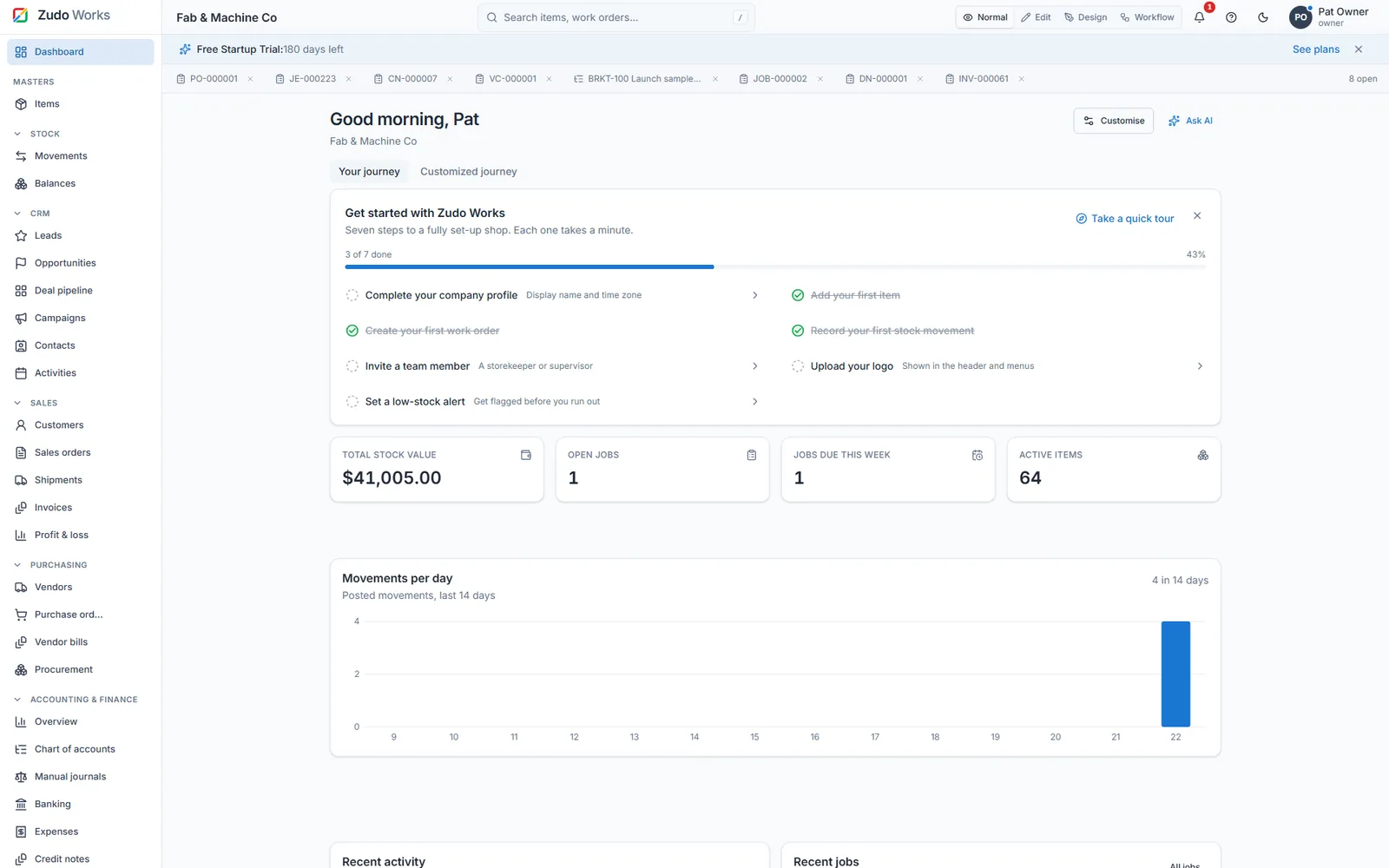
The 20-minute tour covers stock, BOMs, jobs and job cost, sales, purchasing, accounting, quality, CRM, low-code and Zudo AI, recorded on the current build with sample data.
Ask an engineer on WhatsApp; we reply within 6 hours in working hours. Or see ZMOS on your own stock and jobs, free for six months.