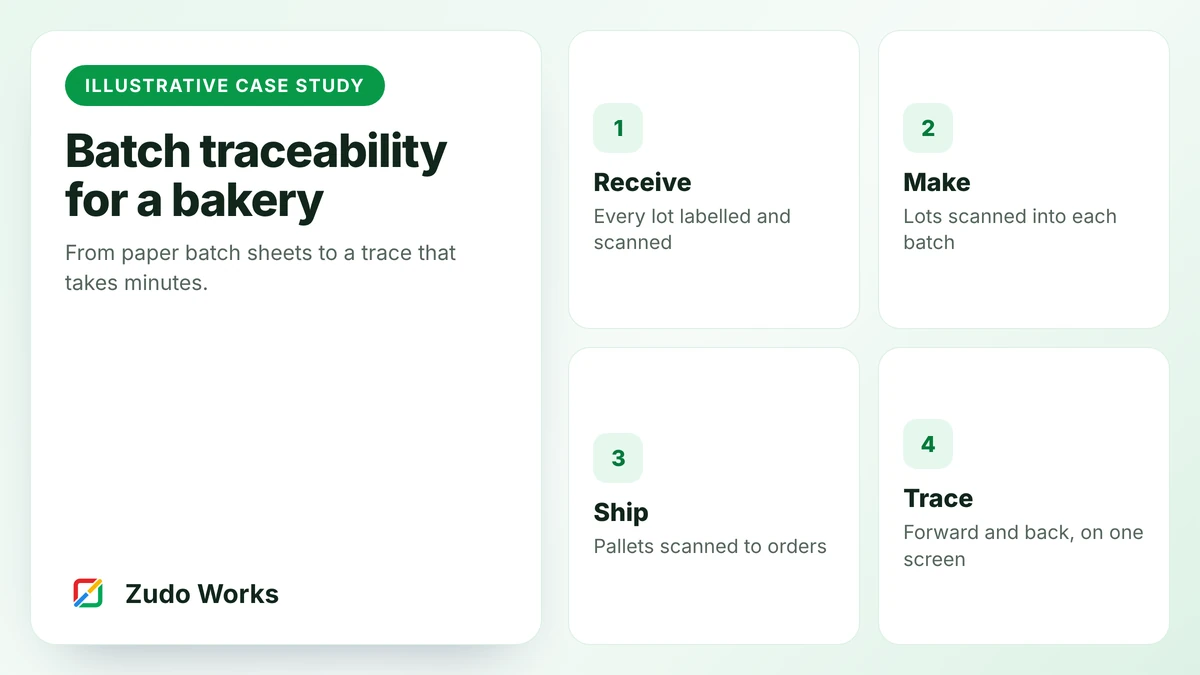
In short
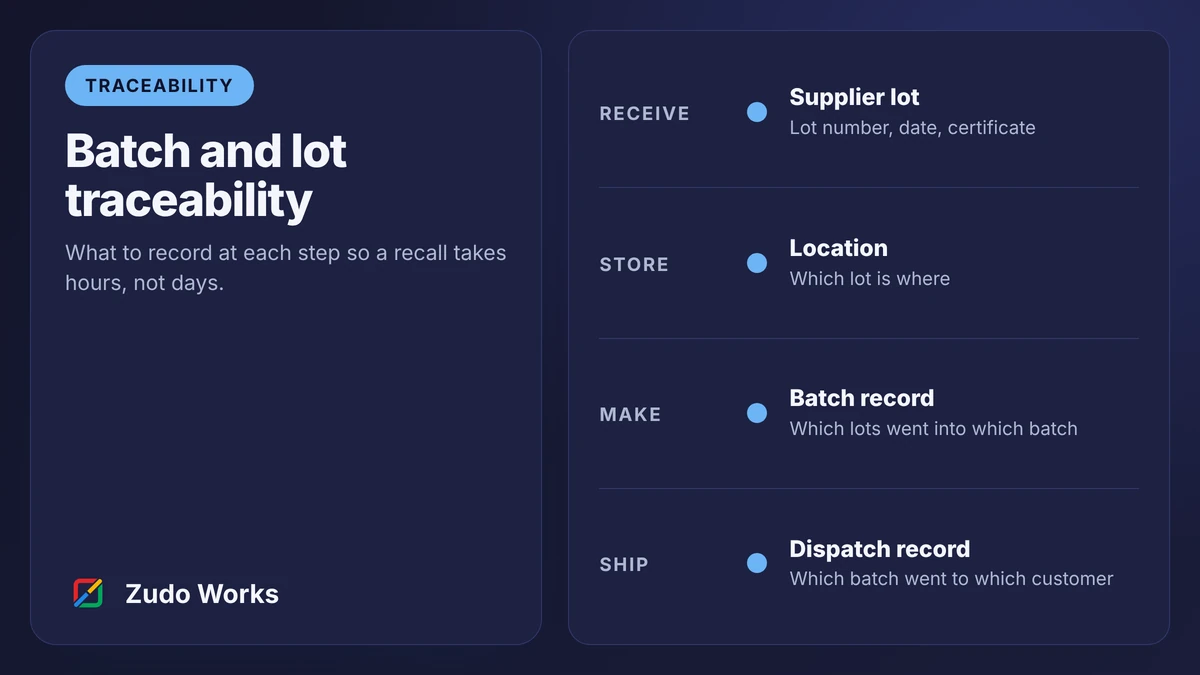
Give every received lot and every production batch a number, and record five links as they happen: lot received, lot stored, lot issued to a batch, batch produced, and finished lot shipped to an order. The link most systems miss is which input lots went into which batch. Prove it works with a timed mock recall.
A customer rings to say there is a problem with a product they bought in March. Three questions follow at once. Which batch was it? What went into that batch? Where did the rest of it go?
A business with working traceability answers in an hour. A business without it recalls everything made that month, because it cannot prove the problem is smaller.
What traceability means in practice
The working standard is one step back, one step forward. For any item you can say who supplied it and who you sold it to. Inside the factory that expands into a chain.
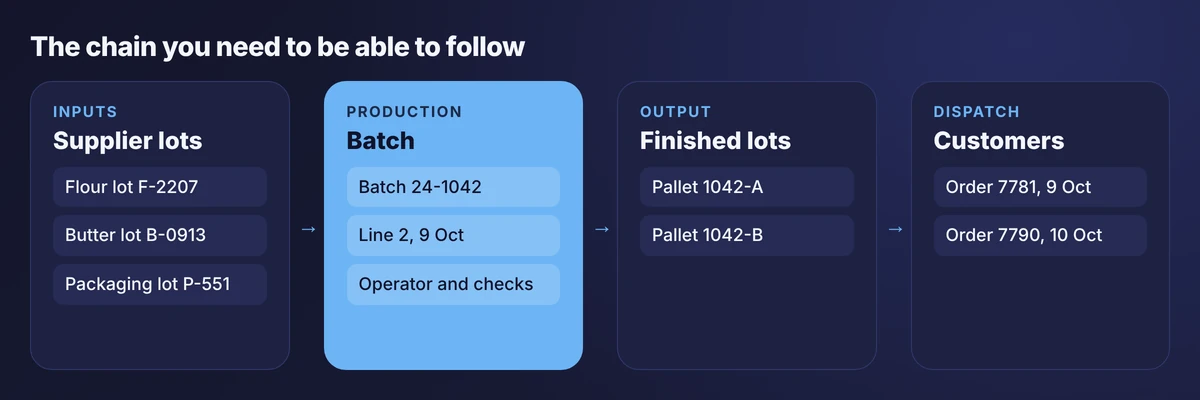
Two terms, because they are often mixed up:
- A lot is a quantity of a material received or made together, which you treat as identical. Your supplier assigns their lot number; you may add your own.
- A batch is one production run. It consumes input lots and produces finished lots.
Traceability is the ability to walk that chain in either direction: forward from an ingredient to every customer who received it, and backward from a finished pack to every input.
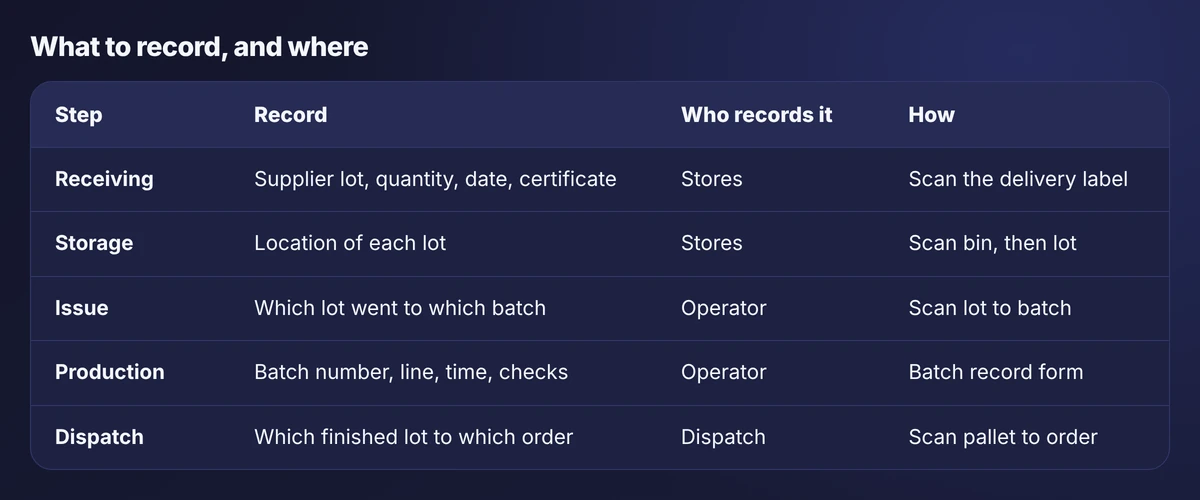
The five recording points
1. Receiving
Record the supplier’s lot number, your own if you assign one, quantity, date and any certificate that came with it. If one delivery contains two supplier lots, that is two records. Label anything you repack.
2. Storage
Know which lot is in which location. This is also what lets you use the oldest lot first and put a lot on hold in one action.
3. Issue to production
This is the link most systems lack. When flour is tipped into a mixer, someone must record which lot went into which batch. If two lots are used in one batch, both are recorded. If a part-used bag goes back to the store, the remaining quantity is recorded against the same lot.
4. Production
The batch record: batch number, product, line, date, operators, the checks carried out and the quantity produced, including rejects.
5. Dispatch
Record which finished lot went on which order. “We shipped 40 cartons to that customer” is not enough if the cartons came from two batches.
What a usable batch record looks like
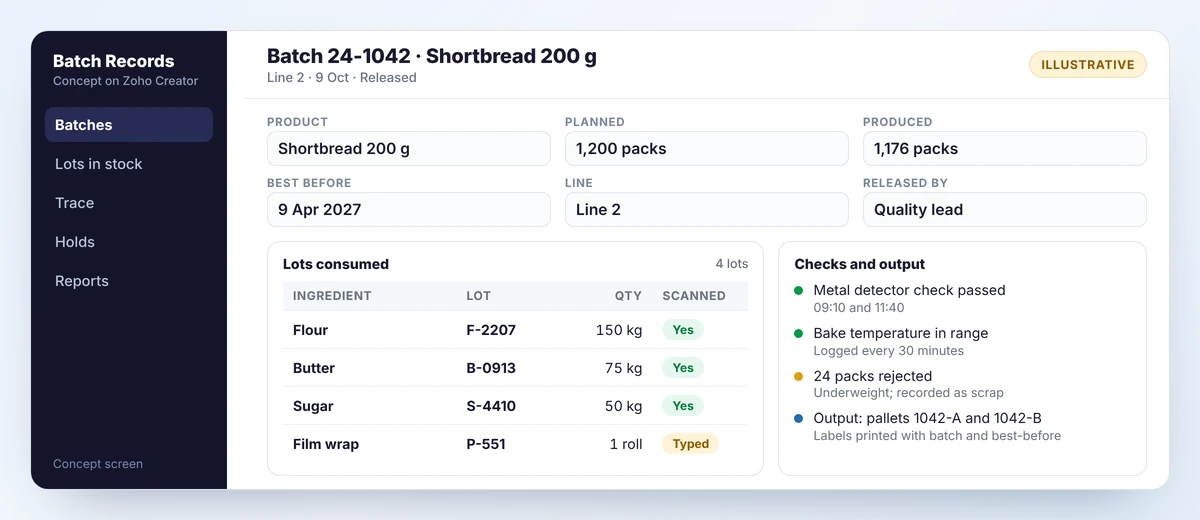
A batch record earns its keep when it is filled in during the run, not afterwards. Design rules that help:
- Scan lots, do not type them. Lot numbers are long and similar. The screen above flags the one that was typed.
- Make the batch number at the start. The system issues it when the run begins, and everything attaches to it.
- Record rejects. Without them, quantities will never reconcile.
- Print the label from the record. Batch number and best-before date come from the system, not from a hand stamp.
Where the systems fit
Stock systems handle the two ends of the chain well. Zoho Inventory, for example, offers serial and batch tracking, including batch expiry dates, across multiple warehouses, with barcode scanning. It can tell you which batch you received and which batch you shipped.
The middle is the problem. Zoho Inventory has no manufacturing module, so it does not record a production run consuming three ingredient lots and producing two finished lots with operator checks attached. That link needs a manufacturing system, or a batch record app built for it.
We build that app on Zoho Creator. Creator forms scan barcodes and QR codes on phones and tablets, which suits a production line. The app writes the consumption and the output back to the stock system, so quantities stay in one place. The principle is the same as in our production tracking guide: the app records the work, the stock system owns the numbers.
What software cannot do
No system can record a lot that has no label. Before any software work, make sure every container in the building carries a lot number someone can scan or read.
Prove it with a mock recall
You do not know whether traceability works until you test it. A mock recall is a timed drill.
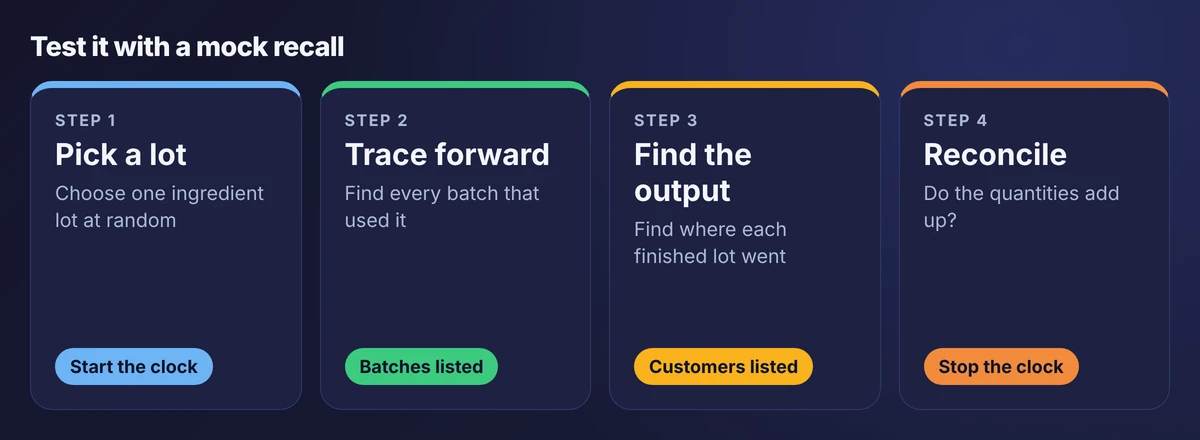
Run it both ways: forward from an ingredient lot, and backward from a finished pack picked off the shelf. Then check the arithmetic. Quantity received should equal quantity used plus quantity still in stock, allowing for recorded waste.
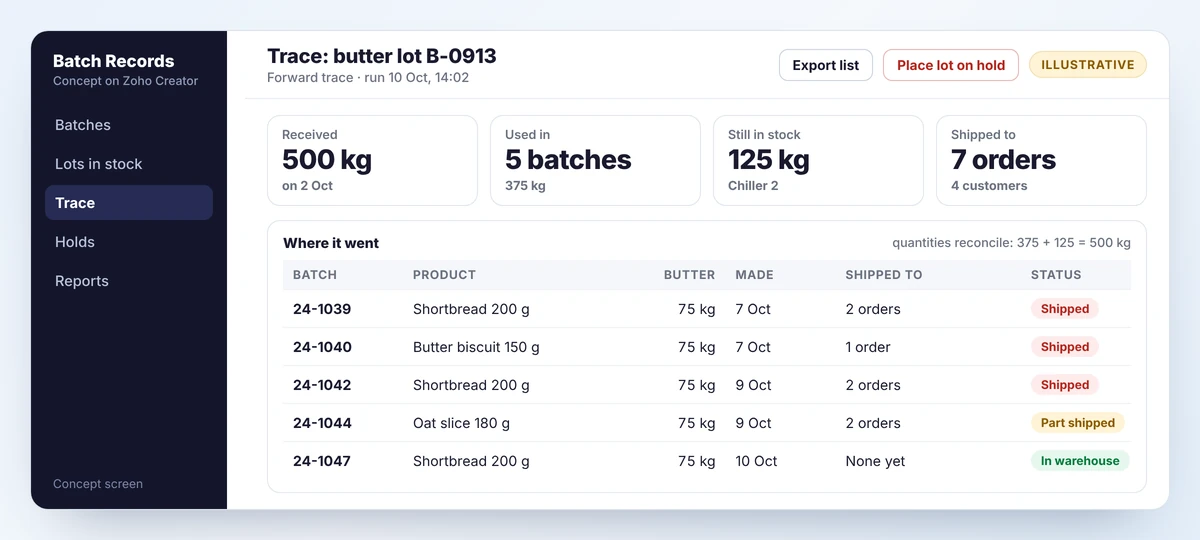
Record how long the drill took and where it stalled. The stalls are your work list. Customers who audit their suppliers, and food regulators in most countries, expect you to be able to do this quickly and to show that you practise it. Check the specific requirements that apply to your products and markets.
A worked example: one complaint, traced
An example bakery receives a call on a Friday: a customer has found a piece of blue plastic in a pack of shortbread. The pack carries batch 24-1042.
- Backward trace. The batch record lists four input lots. The film wrap, lot P-551, is the only blue material on the line. It was also the one lot typed in by hand, so the team checks the roll label against the record. It matches.
- Forward trace on the suspect lot. Lot P-551 was used on three batches over two days. Two have shipped to four customers. One is still in the warehouse.
- Contain. The warehoused batch and the rest of the roll are put on hold in one action. Stock on hold cannot be picked.
- Notify. The four customers get a list of the exact pallets and delivery dates concerned.
- Reconcile. Packs made, less packs rejected, less packs in the warehouse, equals packs shipped. The numbers agree, so nothing is unaccounted for.
The whole exercise is a morning’s work because three batches are in question, not a month of production. Without the lot-to-batch link, the bakery would know only that film was used “that week”, and every pack made that week would be suspect.
Serial numbers, for discrete products
If you make machines or assemblies, the same logic applies with serial numbers in place of finished lots. Record which component lots or serials went into each unit, and which customer each unit went to. A faulty batch of bearings then becomes a list of twelve machines and their owners.
Common mistakes
- Recording by date instead of by lot. “We used flour delivered that week” pulls three lots into every recall.
- Mixing lots in one bin. Once two lots share a silo or a bin without a record, they are one lot for recall purposes.
- Forgetting packaging. Printed film and labels are inputs too, and a wrong label is a common cause of recalls.
- Rework without a record. Product from one batch reworked into another carries its history with it.
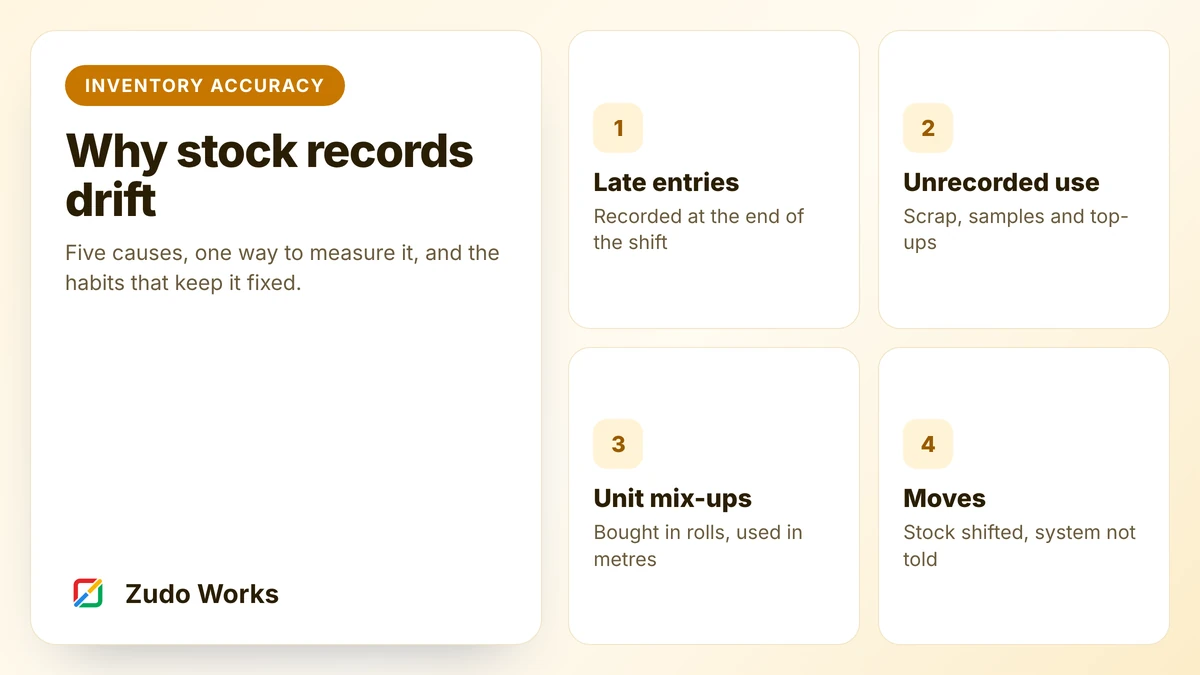
- Writing up records at the end of the shift. See the timing problem in our inventory accuracy guide.
Where to start
- Run a mock recall on paper this week and time it.
- Find the step where the trail went cold. For most businesses it is issue to production.
- Label every lot in the building.
- Put one scan-based record at the weak step, then run the drill again.
Our food manufacturer reference implementation shows the whole design, from receiving to the trace screen.
Frequently asked questions
A lot is a quantity of material received or made together and treated as identical. A batch is one production run. A batch consumes input lots and produces one or more finished lots. Many businesses use the two words loosely, which is fine as long as each has a unique number.
It tracks batches and serial numbers for stock you receive and ship, including expiry dates. It does not record which input lots were consumed by which production run, because it has no manufacturing module. That link needs a batch record app or a manufacturing system alongside it.
Fast enough that you can limit a recall to the affected product the same day. Set your own target, run a mock recall each quarter and record the time. Check whether your customers or regulators set a specific limit.
Strongly recommended. Lot numbers are long and easy to mistype, and one wrong character breaks the chain. A phone camera reading a printed label is enough.
Sources
Product capabilities change. We checked these pages in October 2026; confirm anything you plan around.
Related services: Zoho Creator development · Zoho implementation for manufacturers · Zoho integrations