
Choosing the best HubSpot developer
Most HubSpot work needs no code at all, and the code that is needed comes in three very different kinds: website themes in HubL, custom code inside workflows, and apps built on HubSpot’s developer platform. This guide explains which kind of HubSpot person you need, what good work looks like on each hub, what people charge in 2026, and the seven questions that show whether a developer is current with a platform that changed a lot this year.
Quick answer
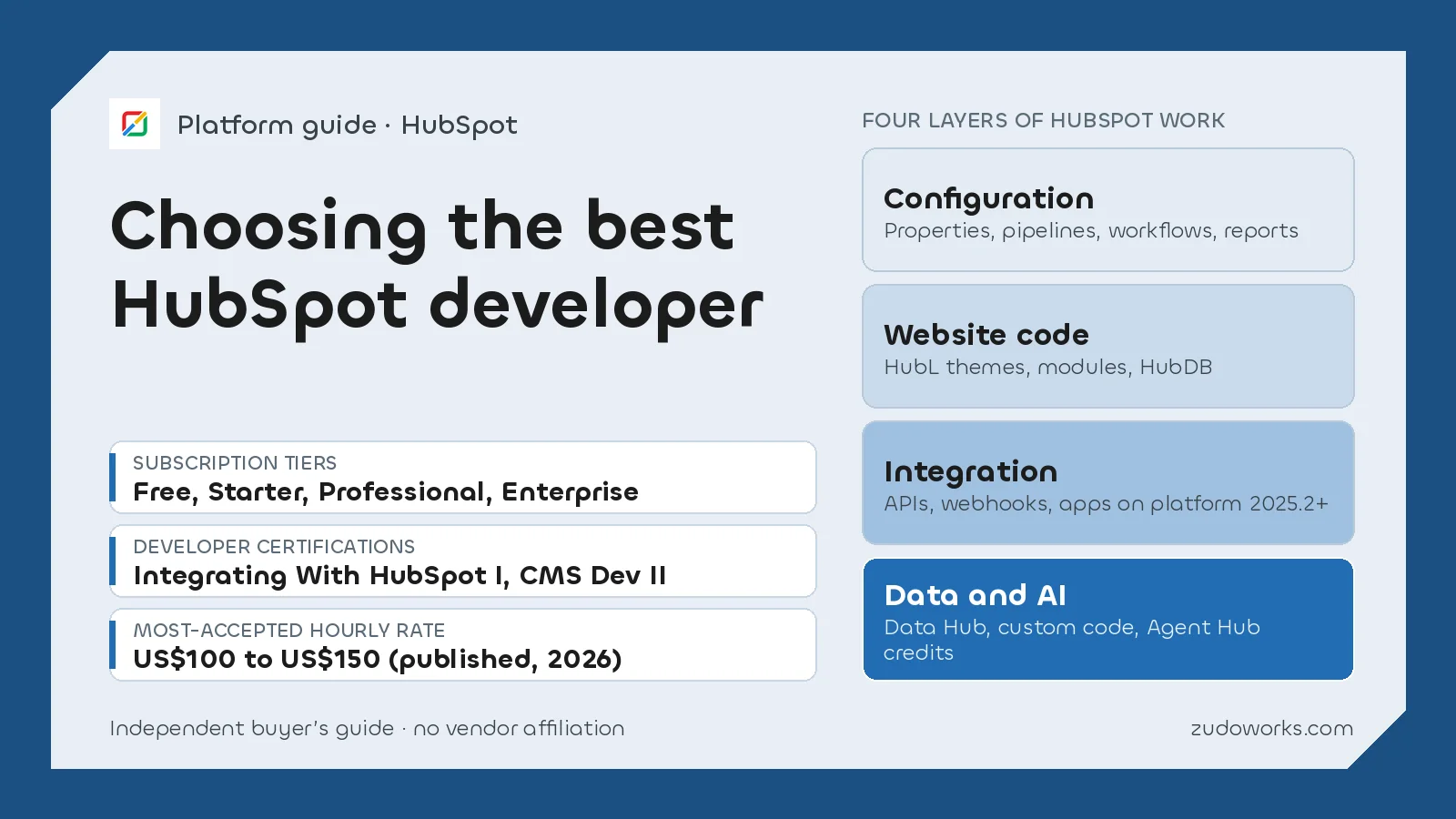
The best HubSpot developer for you has built your kind of work on your hubs and tiers before: a RevOps or admin consultant for pipelines, properties and workflows, a CMS developer for HubL themes, or an integration developer for APIs and apps on the current developer platform. Ask to see current HubSpot Academy certificates (most technical ones last one year), check their apps are on platform version 2025.2 or later, and agree a written scope before work starts.
- Hubs: Marketing, Sales, Service, Content, Data and Revenue Hub, on the shared Smart CRM; Agent Hub for AI agents
- Subscription tiers: free tools, then Starter, Professional and Enterprise
- Developer certifications: Integrating With HubSpot I: Foundations; HubSpot CMS for Developers II: Best Practices
- Most-accepted consultant rate in published benchmarks: US$100 to US$150 an hour (checked 28 November 2026)
Developer, admin, consultant or architect: who you actually need
“HubSpot developer” is used for four different jobs, and most HubSpot projects need the first one more than the other three. Hiring a website developer to fix a sales pipeline, or a marketer to build an integration, is the most common way HubSpot budgets go wrong.
Admin or RevOps consultant
Properties, pipelines and deal stages, lifecycle stages, lists, workflows, permissions and reports. No code, but most of the value. Look for HubSpot Sales Hub Software, HubSpot Marketing Hub Software, HubSpot Service Hub Software, HubSpot Reporting and Revenue Operations.
CMS developer
Website themes, templates and modules in HubL (HubSpot’s templating language), HubDB tables, memberships and serverless functions on Content Hub. Look for HubSpot CMS for Developers II: Best Practices. The original CMS for Developers certification was retired on 30 May 2025; existing holders keep it until it expires.
Integration or app developer
The CRM APIs, webhooks, custom code actions in workflows, and apps built as projects on HubSpot’s developer platform, including React-based app cards inside records. Look for Integrating With HubSpot I: Foundations, plus Data Integrations or CRM Data Migration for sync and migration work.
Solutions architect
Needed when you run several hubs, several brands or business units, custom objects, or a HubSpot and Salesforce sync. Relevant credentials include Solutions Architecture Foundations and HubSpot Architecture I: Data Models & APIs.
What a good HubSpot developer does, product by product
Most businesses use two or three hubs. Ask any candidate to walk you through the ones you use, and the tier you are on.
Marketing Hub
Lifecycle stages everyone agrees on, lead scoring that sales trusts, forms that write to the right properties, and email and campaign reporting. A good consultant also manages your marketing contacts setting, because HubSpot bills marketing contacts by tier and stale lists quietly cost money.
Sales Hub and Revenue Hub
Pipelines and stages that match how you sell, sequences, forecasting, and quoting. Revenue Hub (renamed from Commerce Hub in June 2026) adds CPQ, invoices, payments and subscriptions. The skill that matters is deciding which records drive which numbers, and how quotes and invoices reach your accounting system.
Service Hub
Help desk and ticket pipelines, routing, service levels, a knowledge base and a customer portal. AI agents for customer replies now run from Agent Hub and use HubSpot credits, so ask how they will be tested on real tickets and capped before launch.
Content Hub (website)
Themes and modules that marketers can edit without breaking the layout, HubDB for structured content, redirects and page speed. For a site moving from WordPress, ask for the redirect map and how forms and tracking will carry over.
Data Hub and custom code
Data sync, data quality tools and, from Data Hub Professional, custom code actions in workflows written in JavaScript or Python. HubSpot asked for custom code on Node.js 16 or 20 to be moved to Node.js 24 by 17 November 2026; check that yours was.
Apps, app cards and APIs
Integrations with ERP, accounting, e-commerce or Zoho, and apps built as projects on the developer platform. Projects version 2025.1 reached end of support on 1 August 2026, and classic CRM cards stopped rendering after 31 October 2026, replaced by React app cards. Anything built before 2025 may need work.
HubSpot developer rates and project costs in 2026
We do not publish other vendors’ licence prices, and nobody can price a project before seeing the scope. These are published ranges, dated, so you can sanity-check the quotes you receive.
| Who | Published range | Typical use | Source |
|---|---|---|---|
| Marketplace freelancers (beginner / intermediate / advanced) | US$25 / US$55 / US$150 an hour | Small fixes, templates, one-off workflows | Virtustant, citing Upwork |
| Most-accepted rate across HubSpot proposals | US$100 to US$150 an hour | Typical consultant work: workflows, clean-up, reports | Frontkit |
| Senior HubSpot specialists (US / Europe) | US$200+ / €125+ an hour | Custom objects, complex syncs, architecture | The RevOps Company |
| Specialist HubSpot CMS developer | US$125 to US$200 an hour | HubL themes, website builds and migrations | Bootstrap Creative |
| United Kingdom freelance consultant | £500 to £1,000 a day | UK-based consultants | The RevOps Company |
| Fractional retainer | US$1,500 to US$4,500 a month | Ongoing admin and changes | Bootstrap Creative, via Frontkit |
| Project | Typical scope | Cost range |
|---|---|---|
| Small project | A report, an audit or a set of templates | median about US$1,400 |
| Medium project | Workflow automation, data clean-up or a dashboard | median about US$5,700 (roughly US$700 to US$30,000) |
| Full implementation or migration | New portal, CRM migration or CMS build | median about US$15,000 |
| Enterprise rollout | Several hubs, teams and integrations | can pass US$50,000 |
Three costs people forget. Onboarding: HubSpot charges its own one-time onboarding fee on most Professional and Enterprise purchases; a HubSpot Solutions Partner can deliver that onboarding instead, but an independent developer cannot remove the fee. Contacts and credits: marketing contacts are billed by tier, and agents in Agent Hub use HubSpot credits. Licences are billed by HubSpot, not the developer. See the official HubSpot pricing page for your country. We found no reliable published HubSpot rate ranges for Australia or New Zealand, so compare local quotes against the US and UK figures above.
Four ways to engage a HubSpot developer
Fixed price for a defined scope
Best for a portal set-up, a migration, a website theme or one integration. Insist on a list of properties, pipelines, workflows, templates and reports in the scope.
Hourly against a cap
Best for fixes and small changes: one broken workflow, one report. Agree the cap first and ask for time logs by task.
Monthly retainer
A block of hours each month for changes, campaigns and user questions. Ask how many hours it includes, whether unused hours roll over and what the minimum term is.
Staff augmentation
A HubSpot specialist working inside your team under your direction. Cheaper per hour, but you take on the planning and the review.
Sources:
- Frontkit, how much a HubSpot consultant costs in 2026 (10 October 2026)
- Virtustant, HubSpot consultant rates and options (read 4 November 2026)
- The RevOps Company, HubSpot consultant rates (updated 6 November 2026)
- Bootstrap Creative, freelance HubSpot developer cost (updated 24 November 2026)
- Avidly, HubSpot onboarding in 2026 (who can deliver required onboarding)
- HubSpot Developers, developer platform migration timeline
- HubSpot Knowledge Base, validity period of HubSpot certifications
- HubSpot Knowledge Base, custom code actions in workflows
7 questions to ask any HubSpot developer
Ask every shortlisted developer or firm the same questions, including us, and compare the answers side by side.
- Which hubs and tiers are we on, and what does that change in your design? Features move with tier: custom code actions need Data Hub Professional or Enterprise, custom objects need an Enterprise subscription, and API limits differ between Professional and Enterprise. A good developer checks your subscriptions before quoting, not halfway through the build.
- Can I see your HubSpot Academy certificates, and are they current? Ask for the certificate links from their Academy account and check the name and expiry date. Most technical HubSpot certifications are valid for one year. For website work, ask for CMS for Developers II: Best Practices, since the original CMS for Developers certification was retired in May 2025.
- Will you use a workflow, a custom code action or an external integration, and why? Listen for a rule, not a habit: standard workflows first, custom code when a workflow cannot do it, an external service when the logic is heavy or shared with other systems. If they have written custom code actions for you before, ask whether they moved them to Node.js 24.
- Is your app or integration on the current developer platform? Ask which projects version it uses. Version 2025.1 reached end of support on 1 August 2026 and classic CRM cards stopped rendering after 31 October 2026. HubSpot now ships platform versions every six months with an 18-month support window, so ask who will keep it current.
- How will the sync stay inside API limits, and what happens when it fails? Privately distributed apps get 190 requests per 10 seconds each, and a daily allowance shared across the account (625,000 on Professional, 1,000,000 on Enterprise, per HubSpot’s usage guidelines). Ask how errors are logged, retried and reported to you; silent sync failures are the usual complaint.
- Who owns the portal, the code and the access after go-live? You should hold the super admin login, private apps and access tokens should live in your account, and theme files and app code should sit in a repository in your name. Be wary of a theme or app that only the developer’s own account can update.
- If we use Agent Hub, how will you test it and cap the credits? Agents now use HubSpot credits, and the cost of a custom agent varies run to run. Ask how they will test on real records, set a monthly credit limit per agent and review usage in Agent Inbox before you rely on it.
HubSpot and Zoho: how they compare and connect
Zoho is where most of our work sits, so this is the angle we know best.
Comparing HubSpot with Zoho CRM
Small businesses often shortlist both. HubSpot starts from marketing and adds hubs; Zoho CRM starts from the sales process and adds apps around it. Our Zoho CRM vs HubSpot comparison covers licensing, free plan limits and one-time fees.
Moving from HubSpot to Zoho
Zoho CRM has a direct HubSpot migration under Setup, Data Administration, Import, connected with a HubSpot private app token. Custom modules are not supported in that migration, and workflows, sequences and reports have to be rebuilt. Our migration plan sets out the order of work.
Running both
Some businesses keep HubSpot for marketing and the website, and run quoting, finance, inventory or operations on Zoho. Zoho Flow and Deluge’s invokeurl can call HubSpot’s APIs. See integration services.
When HubSpot is the better fit
Marketing-led teams that want email, website, CRM and reporting in one place, teams already trained on it, and businesses whose agencies all work in HubSpot. We say so when that is the case.
Where Zudo Works fits
Our team includes certified HubSpot consultants with hands-on experience with HubSpot: portal set-up and clean-up, pipelines and workflows, custom code actions and API integrations, and migrations to and from Zoho. We are not a HubSpot Solutions Partner and do not resell licences or HubSpot’s onboarding; you buy those directly from HubSpot, in your own name. Defined projects get a fixed price, small changes are billed hourly against a cap, and every build includes one month of free support.
Where we are a good fit: small and mid-size businesses that need HubSpot fixed, connected to Zoho, accounting or in-house systems, or moved in either direction. Where a HubSpot Solutions Partner may suit you better: a new Professional or Enterprise purchase where you want the partner to deliver HubSpot’s required onboarding, or a large marketing programme run inside HubSpot.
Our Zoho partner application is in progress, so we do not call ourselves a Zoho Partner either. About Zudo Works · How we work · Project experience
Why teams choose Zudo Works
Six things you can check before you sign, whoever else is on your shortlist.
Zoho-certified experts
Your system is designed and built by Zoho-certified experts with hands-on project experience across Zoho CRM, Zoho One, Zoho Creator, Zoho Books and Zoho Projects, not by trainees learning on your account.
Award-winning Creator work
Our CTO, Arunkumar V, received the Master of Creator (Global Winner) award at the Zoho Creator Partner Hackathon 2025, and reviews the architecture of every build.
Zoho first, custom code when it earns its place
We use what Zoho already does well, and write Deluge, APIs or custom software only where a standard app cannot fit your process.
Fixed price for a defined scope
You get a written scope and a fixed price before work starts. Small changes are billed hourly against a cap you agree.
A reply within 6 hours
Working hours are 9:00 to 18:00 IST, Monday to Friday, and every build includes one month of free support and onboarding after launch.
Your account, your data
Licences are bought directly from Zoho in your company’s name, you keep the super-admin login, and every build is documented and handed over.
More reasons teams choose us · Project experience · Send project details
Our Zoho partner application is in progress; until Zoho approves it, we do not call ourselves a Zoho Partner.
Questions about hiring a HubSpot developer
Published benchmarks checked on 28 November 2026: the most-accepted HubSpot consultant rate is about US$100 to US$150 an hour, senior specialists charge US$200 or more, and specialist CMS developers US$125 to US$200. Median project prices run from about US$1,400 for a small job to about US$15,000 for a full implementation or migration. Licences and HubSpot’s onboarding fee are separate.
A consultant or admin configures HubSpot without code: properties, pipelines, workflows, permissions and reports. A developer writes code: HubL themes for the website, custom code actions, or integrations and apps through the APIs. Most projects need mostly consultant work.
For integrations and apps, Integrating With HubSpot I: Foundations. For websites, HubSpot CMS for Developers II: Best Practices. For configuration, the Sales Hub, Marketing Hub or Service Hub Software certifications. Most technical certifications are valid for one year, so check the expiry date.
An independent developer can do almost all HubSpot work. The exception is HubSpot’s required onboarding on most Professional and Enterprise purchases, which is delivered by HubSpot or by a Solutions Partner. Partner status is a commercial relationship; it does not by itself show who will do the work.
Possibly. Developer projects on version 2025.1 lost support on 1 August 2026, classic CRM cards stopped rendering after 31 October 2026, and custom code actions on Node.js 16 or 20 were due to move to Node.js 24 by 17 November 2026. Ask your developer to check each one.
No. Our team includes certified HubSpot consultants with experience with HubSpot, but Zudo Works is not a HubSpot Solutions Partner and does not resell HubSpot licences or onboarding. Our Zoho partner application is in progress.