
Zoho CRM
Pipelines, Blueprint processes, territory and role design, data migration from spreadsheets, HubSpot or Salesforce, and the Deluge functions that tie CRM to the rest of the business.
We build on Zoho every working day, so this is not a brochure. Below are the nine reasons our clients give for choosing Zoho, and the three places where we tell them to be careful.
Quick answer
Businesses choose Zoho because one vendor covers CRM, finance, support and operations at a lower per-user price than Salesforce or Microsoft, with a low-code platform (Zoho Creator and Deluge) for custom processes, data centres in ten regions and a subscription-only business model. Its limits: deep manufacturing, set-up effort across many apps, and thinner niche integrations.
Zoho builds almost all of its apps itself instead of buying and bolting on other companies. CRM, accounting, support, HR, projects and email share one account, one user directory and one admin console, so data moves between them without a third-party connector.
Per-user prices are a fraction of Salesforce, HubSpot or Microsoft Dynamics at comparable editions, and Zoho One puts the whole suite under one per-employee price. Most of our clients first looked at Zoho because of a renewal quote from someone else.
Zoho Creator and Zoho’s scripting language, Deluge, let you build the exact process your business runs: job tracking, approvals, portals and mobile apps. That is where most of our work sits.
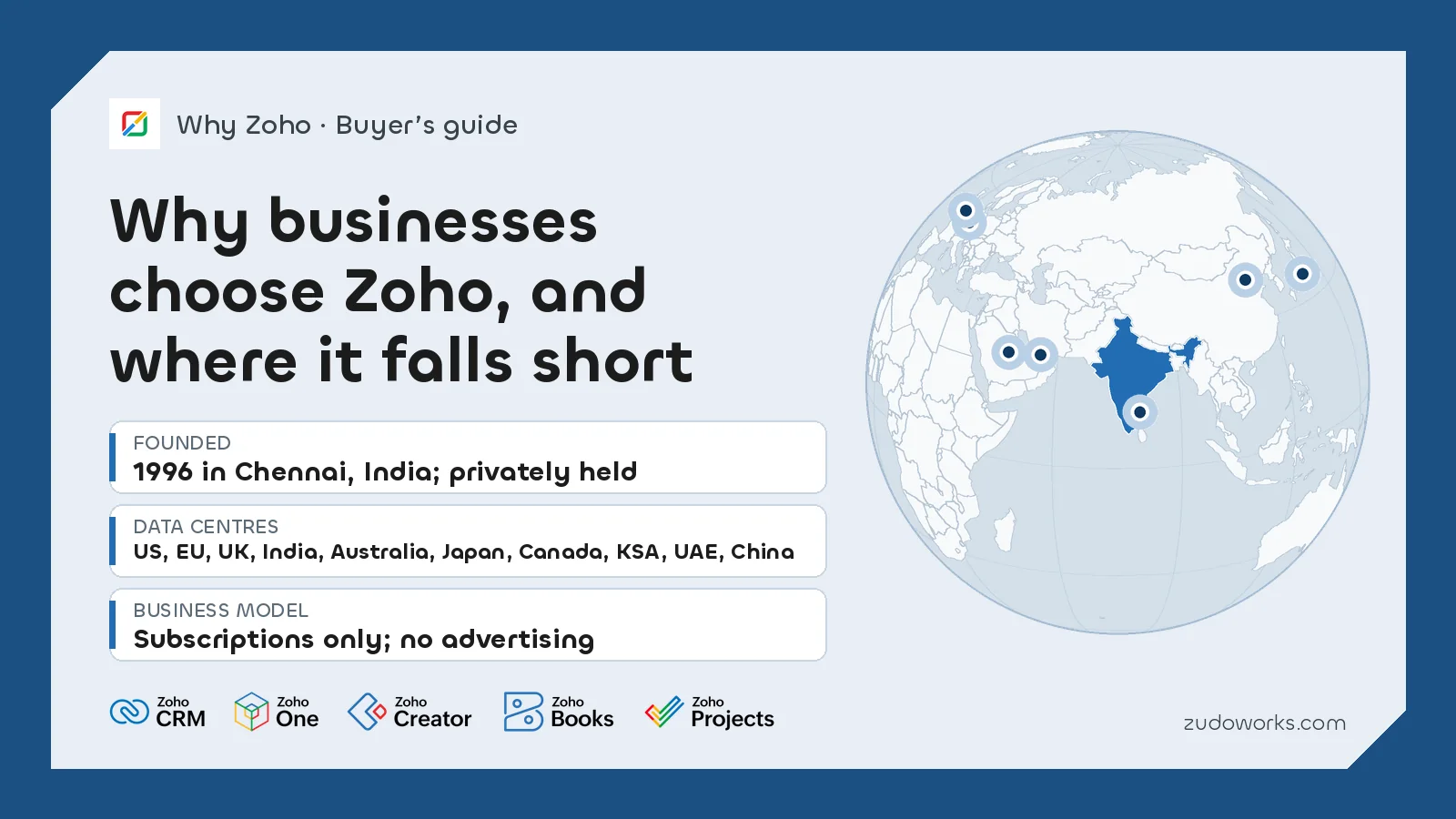
Zoho makes money from subscriptions only. It does not run an advertising business, and its privacy pledge says it will not sell your data or use it for ads.
Zoho runs data centres in the US, EU, UK, India, Australia, Japan, Canada, Saudi Arabia, the UAE and China, so most businesses can keep data in or near their own country.
Zoho Books has country editions for markets including the US, UK, India, Australia, Canada, the UAE, Saudi Arabia, the GCC, Germany, Mexico and Kenya, with e-invoicing built in where the law requires it.
Zoho was founded in 1996 in Chennai, India, and is still privately held. It is not under pressure to raise prices for shareholders or to be sold, which matters when you are choosing a system for the next ten years.
Zia, Zoho’s AI assistant, runs inside the apps, and Zoho’s MCP server lets tools such as Claude or ChatGPT work with your Zoho data under your permissions.
Because Zoho is so widely used in India and growing fast worldwide, finding people who know Deluge, Creator and Zoho CRM is easier and cheaper than for many enterprise platforms.
Every platform has edges. These are the ones we plan around on real projects.
Zoho Inventory handles assemblies, and the newer Zoho ERP goes further, but job shops that need routings, work centres and true job costing often need Zoho Creator or a manufacturing ERP alongside. See our Zoho apps or a manufacturing ERP guide.
With 45-plus apps in Zoho One, it is easy to switch on too much. Without a plan, teams end up with half-configured tools and duplicate data.
Zoho’s native connectors cover the big names, but niche local tools often need Deluge or middleware. Budget for it.
Pipelines, Blueprint processes, territory and role design, data migration from spreadsheets, HubSpot or Salesforce, and the Deluge functions that tie CRM to the rest of the business.
Choosing which of the 45-plus apps you actually switch on, one admin model for users and roles, and a rollout order so the team is not asked to learn ten tools in a week.
Custom apps where an off-the-shelf module does not fit: job tracking, approvals, portals for customers or suppliers, and mobile apps for field and floor teams.
The right country edition and tax set-up from day one, chart of accounts, invoice templates, bank feeds, and the link from CRM deals to Books invoices.
Project templates, task dependencies, timesheets that flow into invoicing, and client portals so customers see progress without asking for it.
You can set up Zoho yourself, hire a listed Zoho partner, or work with an independent Zoho developer. Our Zoho partner guide explains the options and has guides for 7 regions and 24 countries.
Zudo Works’ application to Zoho’s partner program, covering Zoho CRM, Zoho One, Zoho Creator, Zoho Books and Zoho Projects, is in progress, so we do not call ourselves a Zoho Partner yet. Our team includes Zoho-certified experts with hands-on project experience, and our CTO received the Master of Creator (Global Winner) award at the Zoho Creator Partner Hackathon 2025.
Six things you can check before you sign, whoever else is on your shortlist.
Your system is designed and built by Zoho-certified experts with hands-on project experience across Zoho CRM, Zoho One, Zoho Creator, Zoho Books and Zoho Projects, not by trainees learning on your account.
Our CTO, Arunkumar V, received the Master of Creator (Global Winner) award at the Zoho Creator Partner Hackathon 2025, and reviews the architecture of every build.
We use what Zoho already does well, and write Deluge, APIs or custom software only where a standard app cannot fit your process.
You get a written scope and a fixed price before work starts. Small changes are billed hourly against a cap you agree.
Working hours are 9:00 to 18:00 IST, Monday to Friday, and every build includes one month of free support and onboarding after launch.
Licences are bought directly from Zoho in your company’s name, you keep the super-admin login, and every build is documented and handed over.
More reasons teams choose us · Project experience · Send project details
Our Zoho partner application is in progress; until Zoho approves it, we do not call ourselves a Zoho Partner.
Mostly cost and breadth: Zoho covers CRM, finance, support and operations from one vendor at a lower per-user price, with a low-code platform for custom processes. Very large or heavily customised sales organisations still sometimes fit Salesforce better.
Zoho runs its own data centres in ten regions, holds major security certifications, and its business model is subscriptions only, with a pledge not to sell customer data or use it for advertising. How safe your setup is also depends on roles and access, which is part of any good implementation.
Zoho Corporation was founded in 1996 in Chennai, India, and is privately held. It has offices and data centres around the world.
When a process needs deep, industry-specific software Zoho does not offer, such as full manufacturing execution, or when a business is locked into another ecosystem with heavy custom code. In those cases Zoho can still sit alongside the specialist system.