

Most Australian and New Zealand businesses that look for Zoho help start close to home. That makes sense for an electrician or an accountant. For Zoho it matters less, because the work happens inside your own Zoho account, on Zoho’s servers, through a browser. A consultant in the next suburb and a developer in another country log in to the same screens.
Distance still changes some things: who can sit in your office, which hours you can reach them, how GST is handled and what privacy law asks of you. Those points were checked on the pages of Zoho, the Office of the Australian Information Commissioner (OAIC), the New Zealand Privacy Commissioner, the ATO and Inland Revenue on 25 November 2026, and are linked below. This is general information, not legal or tax advice. We are a remote Zoho development team based in India, so read this with that in mind. We have tried to say plainly where a local firm is the better choice.
The short answer
- You do not need a consultant in your city. Skills, proof of similar work and clear contract terms matter more than the postcode.
- Choose a local firm when you want workshops on site, advice that leans on Australian or New Zealand accounting practice, or a contract with a local company under local law.
- Choose a large partner when the project covers many Zoho apps, many users or several countries at once.
- A remote team works well for defined builds: Zoho Creator apps, Deluge scripts, integrations, CRM set-up and fixes.
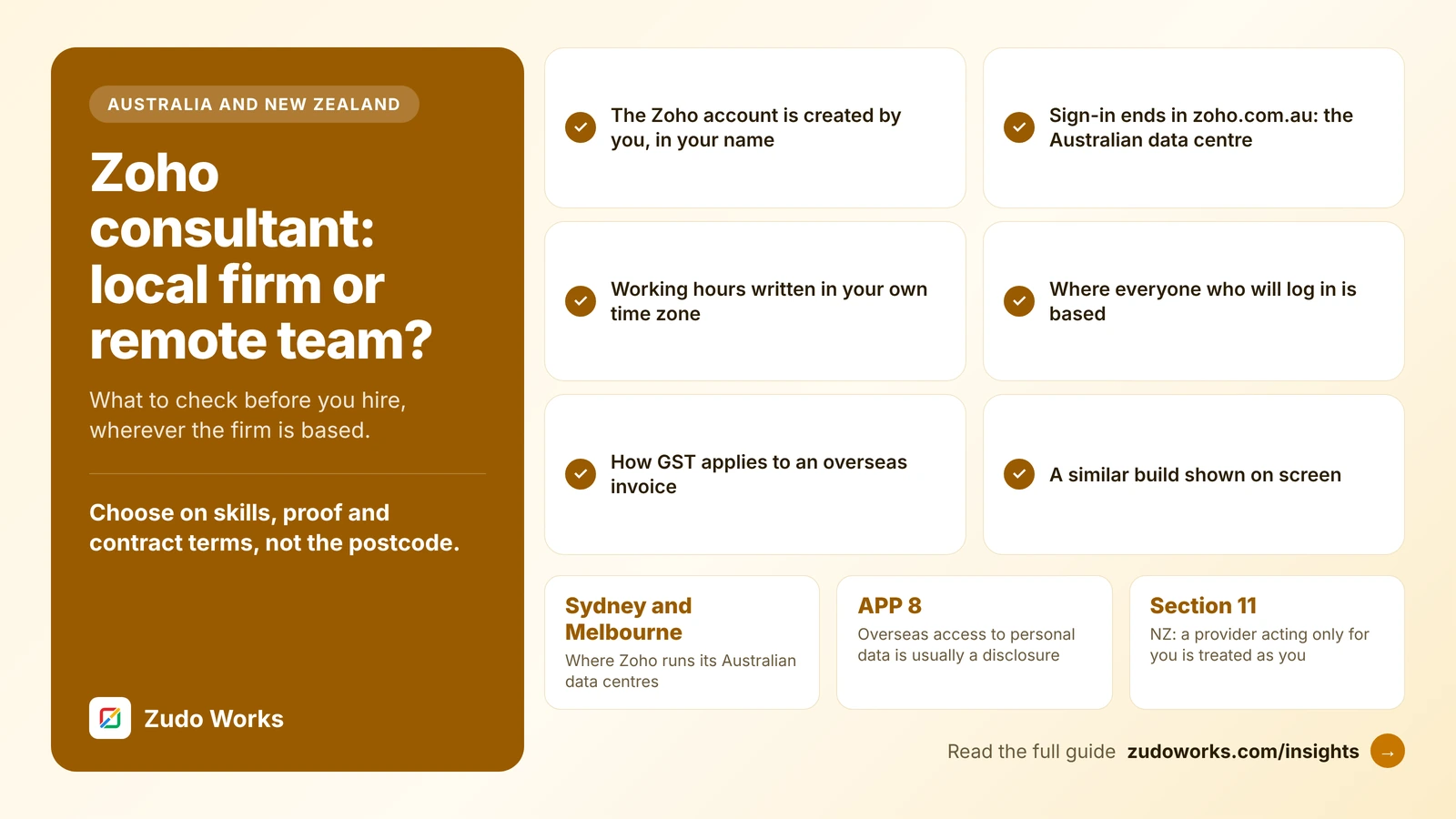
- Whoever you choose, keep the Zoho account in your name, check that it sits in Zoho’s Australian data centre, ask where the people who will log in are based, and get the scope in writing.
Who you can hire for Zoho work
The words consultant, developer and partner are used loosely. In practice an Australian or New Zealand buyer meets four kinds of provider.
A local consultancy. A small firm, often a handful of people in one capital city, serving businesses in its state or region and beyond. Some hold a tier in Zoho’s partner programme and some do not. The usual strength is the first half of a project: sitting with your team, mapping how work moves and deciding which Zoho apps to use.
A large partner or integrator. More people and more Zoho products under one roof, often with offices in several countries. Ask who you will work with day to day, because it is rarely the person who ran the sales call, and ask where the delivery team sits.
A remote specialist team. A development team in another country that works online. The usual strength is the second half of a project: building the app, writing the scripts and connecting systems. We are one of these.
A freelancer. One person, local or abroad. Good value for small, well-defined jobs. The risk is cover when that person is ill, on leave or busy with another client.
A consultant decides what should be built and why. A developer builds it. Many firms do both, and our guide to choosing a Zoho development partner or developer covers the questions to ask each.
Local firm and remote team side by side
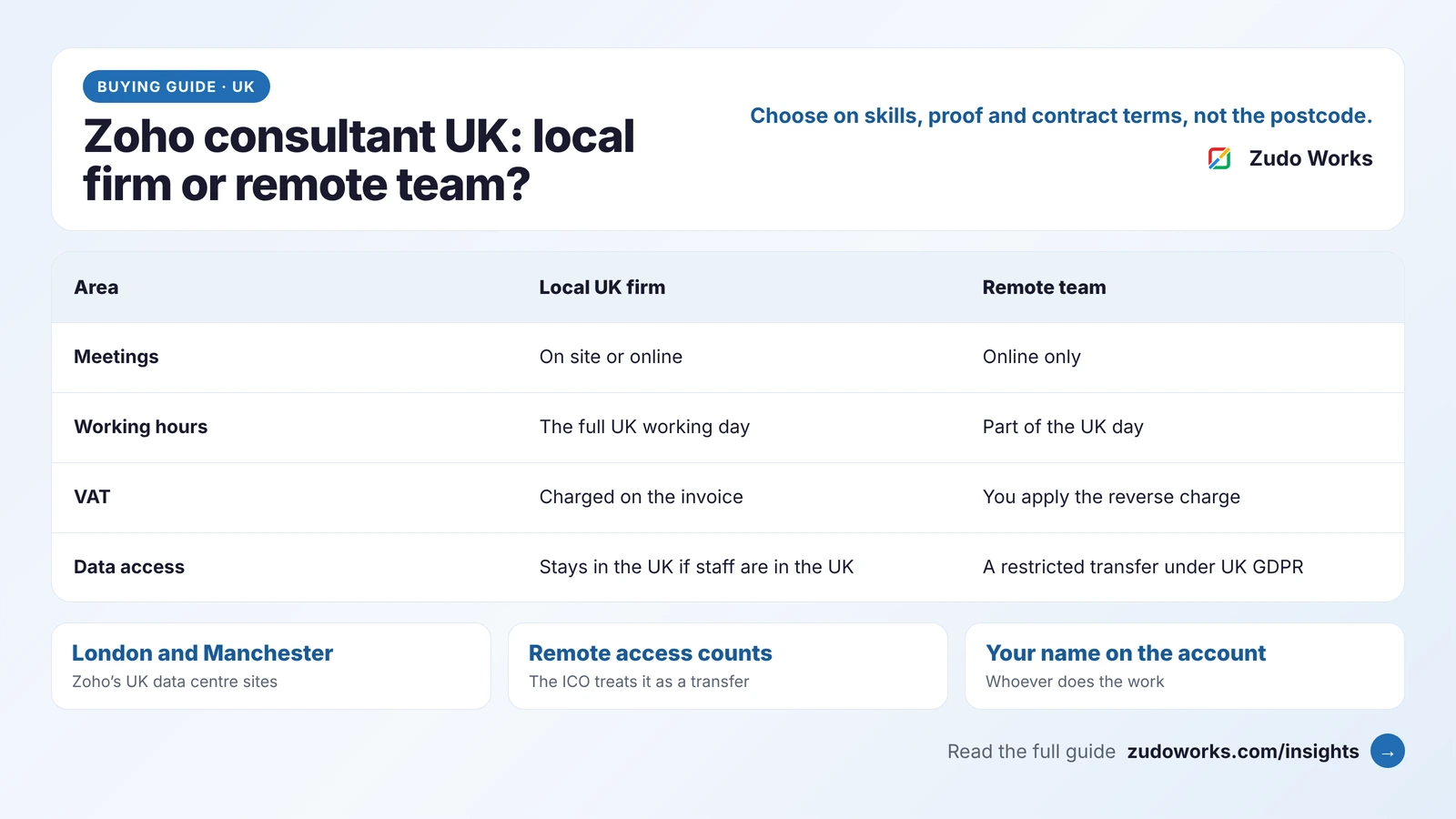
The table describes what is typical. Individual firms differ, so treat each cell as a question to ask.
| Area | Local Australian or NZ consultancy | Remote specialist team |
|---|---|---|
| Meetings | On site or online | Online only |
| Hours | Your full working day | Part of your day; ask for the overlap in your own time zone |
| Best for | Process workshops, accounting-led projects, teams that want face-to-face contact | Defined builds: Creator apps, Deluge, integrations, CRM set-up, fixes |
| Contract | A local company, under local law | An overseas entity; check the governing law and payment terms |
| GST | Charged on the invoice if the firm is registered | No local GST on the invoice; the reverse charge applies only in some cases |
| Privacy | No overseas disclosure if everyone with access is local | Australia: access from abroad is usually a disclosure under APP 8. NZ: depends on whether the provider acts only for you |
| Ask first | Who does the building, and whether any of it is subcontracted offshore | Proof of similar work, overlap hours, documentation and handover |
A large partner sits between the two. If a local entity signs and invoices, the contract and GST work as they do for a local firm, but the delivery team may still be abroad. That matters for privacy, as the section below explains, so ask.
When a local consultant is the better choice
- The process is not yet agreed. If sales, operations and accounts disagree about how quotes, jobs or orders should flow, a day in one room with a whiteboard settles more than a week of video calls.
- The project is led by accounting. Moving the books to Zoho Books touches GST settings, BAS or GST returns, payroll journals and your accountant’s habits. A firm that works with local accountants every week will know the questions before you ask them. If your accountant prefers Xero or MYOB, a local firm will also know how they are used in practice; our Zoho Books vs Xero comparison covers the product side.
- Staff need hands-on training. Some teams learn better with a trainer in the room, especially on a site, in a workshop or in a warehouse.
- Procurement requires it. Some organisations can only buy from a locally registered supplier, under a contract governed by Australian or New Zealand law, with local insurance.
- Personal data must not leave the country. If your own policy, a customer contract or a government contract says data must not be accessed from overseas, the choice is made for you.
- You need someone in your morning. A team in Asia, Europe or the Americas will not cover the start of an Australian or New Zealand business day. The hours table below shows the pattern.
When a remote team works as well
Once the requirement is clear, most Zoho work is building, and building does not need a visit.
- A defined Zoho Creator app. Forms, reports, a portal, PDFs and the rules behind them can be specified in writing and shown in weekly demos.
- Deluge scripts and custom functions. Code is reviewed on a screen, not across a desk.
- Integrations. Connecting Zoho to an accounting package, a web shop or an in-house system is API work, tested in a sandbox. Our guide to the Zoho and QuickBooks integration shows what that work looks like.
- Zoho CRM set-up after the process is agreed. Modules, Blueprints, automation and data migration follow a plan. Our Zoho One implementation checklist shows the order.
- Fixes and small changes. A support request is the same whether it is answered from Parramatta or from abroad.
Many businesses mix the two: a short piece of local consulting to agree the process, then a remote team for the build. That works if one document, a written scope, passes between them.
Zoho’s Australian data centre
Where your Zoho data is stored is decided when the account is created, not when you hire a consultant. Zoho’s help page on data centres says it assigns a data centre from the user’s location by default, detected from the IP address, and that each account and its data live in one data centre. Australia is one of the regions listed, and accounts there sign in at accounts.zoho.com.au. Austrade’s July 2026 profile of Zoho says Zoho has data centres in Sydney and Melbourne, set up in 2019.
Three practical points follow.
- Create the account yourself, from Australia or New Zealand. If a consultant overseas signs up on your behalf, the IP address may put the account in another region. Check the address bar after you sign in.
- New Zealand businesses should check too. Zoho’s help page does not list a separate New Zealand region, so look at which domain your account uses after sign-up.
- Moving later is not self-service. Zoho says an organisation admin can ask its migrations team to move an account to another data centre, and that a few services may not support it.
Most Zoho Creator features are the same in every region. Zoho’s feature availability page lists the Australian Creator address as creator.zoho.com.au, and on 25 November 2026 the one gap it listed for Australia was SMS-based OTP login for portals. The page calls itself a work in progress, so check it before you plan a customer portal. Our Zoho Creator customer portal guide covers the rest of the portal set-up.
Privacy: APP 8 in Australia, section 11 in New Zealand
Storage location and access are two different questions. Your data can sit in Sydney while a developer in another country logs in to work on it. The two countries treat that access differently.
Australia. The OAIC’s guide to sending personal information overseas says that providing personal information to an overseas recipient, including a contractor located overseas, is in most circumstances a disclosure. Before that disclosure, Australian Privacy Principle 8.1 asks you to take reasonable steps to make sure the recipient does not breach the APPs, and the OAIC says an enforceable contract is the step it generally expects. Under section 16C you remain accountable if the overseas recipient does something that would breach the APPs. The OAIC also explains that giving information to a cloud provider only to store it, under a contract that keeps it in your effective control, may be a use rather than a disclosure, and adds that the difference “should not be overstated”. The page notes it is being updated for the Privacy and Other Legislation Amendment Act 2024, which added a new exception to APP 8.1.
New Zealand. The Privacy Commissioner’s guide to working with third-party providers explains section 11 of the Privacy Act 2020. When a provider holds or processes information solely on your behalf, it is not treated as holding the information and you are not disclosing it to the provider. Your organisation stays fully responsible for what happens to it: in the Commissioner’s words, the third party is “you” for the purposes of the Act. The cross-border rule in IPP 12 may come into play if an overseas provider also uses the information for its own purposes.
Two practical points apply in both countries.
- The rules follow the people, not the letterhead. A local firm that passes your build to a team abroad gives that team the same access. Ask every firm, local or not, where the people who will log in are based.
- Less access means less to cover. Much of a build can be done in a sandbox or with sample records. Give access to live personal data only when the work needs it, through a named user with the narrowest role, in a written contract that limits use to your work, and remove the access at the end.
GST on an overseas consultant’s invoice
An overseas firm that is not registered for Australian or New Zealand GST will send an invoice without GST. Whether you then have to account for GST yourself is narrower than many buyers assume.
Australia. The ATO’s page on reverse charge GST on offshore purchases says the reverse charge applies to a business that is registered or required to be registered for GST when it buys something for its Australian business and the purchase is partly of a private or domestic nature, or relates partly or solely to making input-taxed supplies. A business whose purchase is wholly for making taxable supplies is not caught.
New Zealand. Inland Revenue’s technical note on imported services sets the reverse charge threshold at 95 per cent: a registered business accounts for GST on imported services when its taxable use of them is below 95 per cent of total use. A business that uses the services only to make taxable supplies is above it.
Your accountant should confirm how this applies to you. On the product side, Zoho’s Australian Zoho Books page covers GST invoices and BAS reports, and its Australian tax help includes Simpler BAS. Any competent Zoho firm can set these up; deciding how a transaction should be treated is your accountant’s job.
Working hours: do the sum in your own time
“We overlap with Australian hours” can mean an hour or a whole afternoon. Ask for the firm’s working day written in your own time zone, for both summer and winter. New South Wales, Victoria, the ACT, Tasmania, South Australia and New Zealand move their clocks; Queensland, Western Australia and the Northern Territory do not. Many supplier countries do not change their clocks at all. These are our own hours, 9:00 to 18:00 India time, Monday to Friday, as published on our site:
| Your city | Summer (daylight saving) | Winter |
|---|---|---|
| Sydney, Melbourne, Canberra, Hobart | 14:30 to 23:30 | 13:30 to 22:30 |
| Brisbane | 13:30 to 22:30 | 13:30 to 22:30 |
| Adelaide | 14:00 to 23:00 | 13:00 to 22:00 |
| Perth | 11:30 to 20:30 | 11:30 to 20:30 |
| Auckland, Wellington | 16:30 to 01:30 | 15:30 to 00:30 |
For an east-coast office that works 9 to 5, that is about two and a half hours of shared time in summer and three and a half in winter, all in the afternoon. Perth gets most of its day. New Zealand gets the least: half an hour to an hour and a half at the end of the day. A team in India suits a business that holds calls after lunch and is happy for work to carry on overnight; it does not suit a New Zealand team that needs someone on the phone at 10 in the morning. Ask any overseas firm for the same table.
How to check any Zoho firm, local or remote
- Look them up in Zoho’s directory. The Find a Zoho Partner page filters by country, state, product and industry. If a firm claims a partner tier, it should appear there. Our guide to the Zoho Partner Program explains what the tiers do and do not tell you.
- Check the company. An Australian business can be looked up free of charge on ABN Lookup, and a New Zealand company on the Companies Register. For an overseas firm, ask for the registered legal name and where it is registered.
- Ask to see similar work. A screen share of a real app, with the code behind it, tells you more than a slide deck. Our checklist for choosing a Zoho Creator developer lists what to look for.
- Start small. A paid task of a few days shows how a firm communicates, estimates and documents before you commit to the whole project.
- Compare quotes by hours. Day rates differ widely between firms and countries, so ask each one for the estimated hours as well as the price. Our Zoho CRM implementation cost breakdown gives typical hours for three project sizes.
Checklist: questions to ask before you sign
- Is the Zoho account created by us, in our name, with our own super admin?
- Does the sign-in address end in zoho.com.au, and is that the data centre we want?
- Do any features we plan to use, such as portal SMS login, differ in the Australian data centre?
- Who will do the work, by name, and in which country is each person based?
- Is any part of the work passed to another company, here or overseas?
- If anyone is overseas, what does the contract say about how they handle our personal information?
- Can the build be done in a sandbox or with sample data?
- What are your working hours in our time zone, in summer and in winter?
- Which legal entity signs the contract, and under which law?
- Will the invoice include GST, and has our accountant confirmed whether the reverse charge applies?
- Is the price fixed or hourly, and how many hours is it based on?
- What documentation, training and support after launch are included?
Where Zudo Works fits
We are a remote team in India that builds on Zoho for businesses in Australia, New Zealand and elsewhere. Our pages for Australian businesses and New Zealand businesses set out how that works. In the terms of this guide:
- We do not visit. Discovery, demos and training are held online. If you need someone in the room, choose a local firm.
- Our day covers your afternoon. We reply within 6 hours during the working hours in the table above. For New Zealand the overlap is short, and we say so up front.
- We are not a Zoho Partner. Our application is in progress, and until it is approved we do not use the name, and you should not expect to find us in Zoho’s directory. Our CTO, Arunkumar V, received the Master of Creator (Global Winner) award at the Zoho Creator Partner Hackathon 2025.
- We are overseas. In Australia, giving us access to personal information is in most cases a disclosure under APP 8, so agree the contract terms before we log in. We work inside the account you choose, with the narrowest access the work needs; see our privacy policy.
- The account stays yours. Zoho licences are billed by Zoho to you, and documentation is handed over at the end. How we work gives the detail.
- Pricing is agreed in writing first. Defined projects get a fixed price, smaller work is billed hourly against an agreed cap, and every build includes one month of free support. See pricing.
If the requirement is clear and the work is a build, a remote team such as ours is worth a place on the shortlist beside a local firm. Our Zoho development services page lists what we take on, and our guide for UK businesses covers the same choice under UK rules.
Watch and share
The same guide as a short video, on the channels where we post it. Share the one that suits the person you are sending it to.
- YouTube: the 50-second video
- YouTube Shorts: the vertical version
- Instagram: the Reel
- Facebook: the Reel
- LinkedIn: Zudo Works page
- LinkedIn: Arunkumar V
- Instagram: the four-slide guide
- Facebook: the four-slide guide
- LinkedIn: Zudo Works page, four slides
- LinkedIn: Arunkumar V, four slides
- Threads: the short version
- Mastodon: the short version
Frequently asked questions
Frequently asked questions
Do I need a Zoho consultant near me in Australia?
No. Zoho runs in a browser and the work is done inside your own Zoho account, so a consultant does not need to be nearby. A local firm is worth choosing when you want on-site workshops or training, advice tied to Australian accounting practice, or a contract with an Australian company. For defined builds a remote team works as well.
Does Zoho have a data centre in Australia?
Yes. Zoho lists an Australian data centre region, and accounts there sign in at accounts.zoho.com.au. Austrade says Zoho has data centres in Sydney and Melbourne, set up in 2019. Zoho assigns the data centre from your location at sign-up, so create the account yourself from Australia or New Zealand and check the sign-in address.
Is it legal to use an overseas Zoho developer in Australia?
Yes, with care. The OAIC says giving personal information to an overseas contractor is in most circumstances a disclosure, so APP 8.1 asks you to take reasonable steps, usually an enforceable contract, so the contractor does not breach the APPs. Under section 16C you remain accountable for its acts. This is general information, not legal advice.
Can a New Zealand business use a Zoho developer overseas?
Yes. The Privacy Commissioner explains that under section 11 of the Privacy Act 2020, a provider that handles information solely on your behalf is treated as you, so you are not disclosing it, but you stay fully responsible for what happens to it. IPP 12 can apply if the provider also uses the information for its own purposes.
Do I pay GST on an overseas Zoho consultant’s invoice?
Usually not. An unregistered overseas firm invoices without GST. In Australia the reverse charge only applies when the purchase is partly private or relates to input-taxed supplies. In New Zealand it applies when taxable use of the services is below 95 per cent. Ask your accountant to confirm.
Is Zudo Works a Zoho partner in Australia or New Zealand?
No. Our Zoho Partner application is in progress, and until it is approved we do not describe ourselves as a Zoho Partner. We are an independent Zoho development team in India that works with Australian and New Zealand businesses remotely, with a working day that covers the afternoon on the east coast of Australia.