
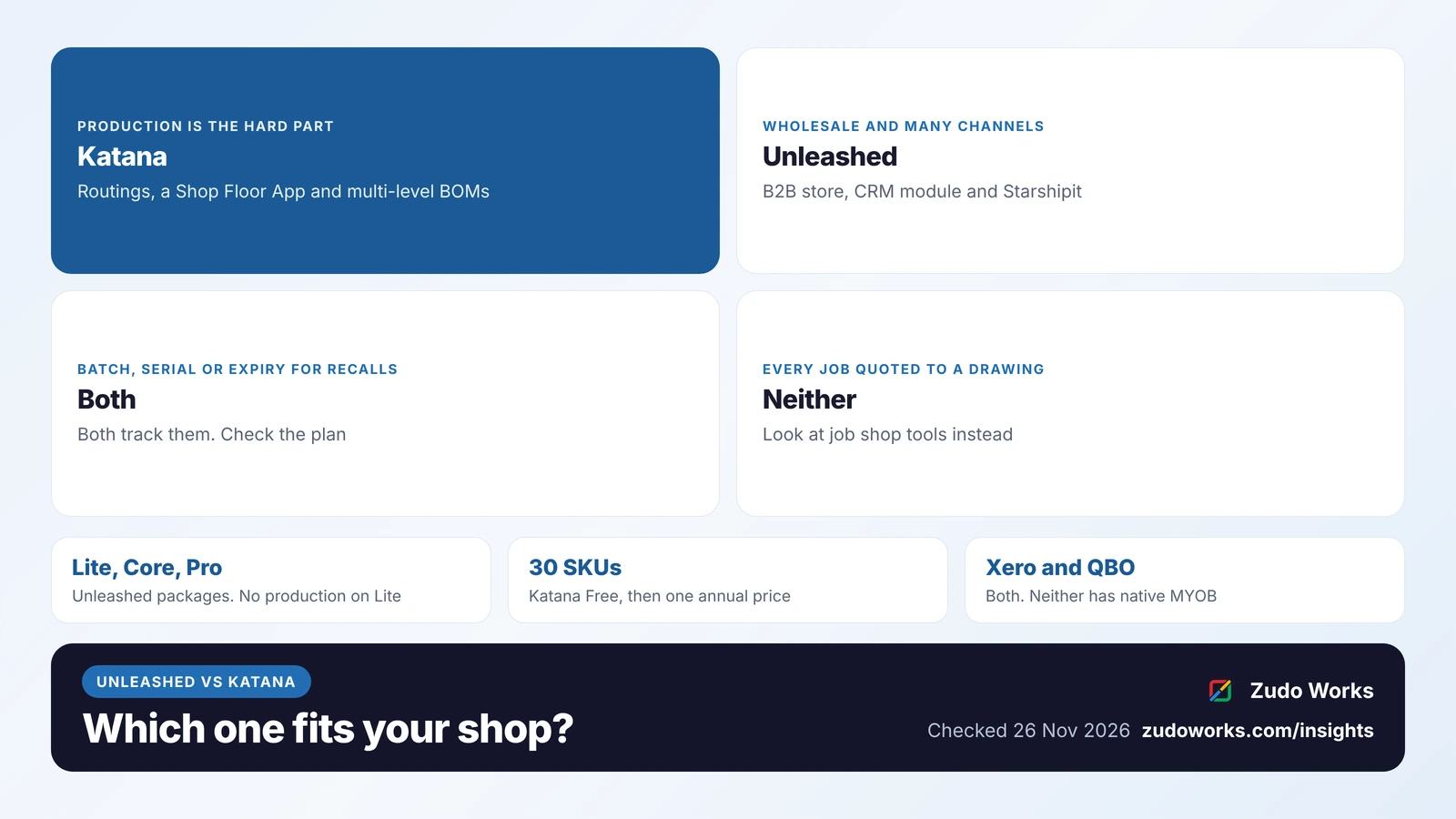

If you make a product in Australia or New Zealand and have outgrown spreadsheets, Unleashed and Katana are two of the first names you will meet. Both run in a browser, both track stock, bills of materials and purchase orders, and both connect to Xero. Unleashed was founded in Auckland and has offices in Australia and the UK. Katana is an Estonian company with customers around the world. On a shortlist they look alike. In daily use they lean in different directions.
This comparison is for makers of roughly 5 to 50 people: food and drink producers, cosmetics and supplement brands, furniture and fabricated products. We read both vendors’ own pricing, feature and help pages on 26 November 2026 and report what they say. We do not quote other vendors’ prices; we link to their pricing pages. We make ZMOS, our own manufacturing software, and we build on Zoho, so we have an interest. The section on ZMOS says plainly where it is the wrong choice.
The short answer
- Unleashed is inventory software first. Its own comparison page calls it primarily an inventory management solution with manufacturing features. Stock, wholesale orders and sales channels are its strengths.
- Katana puts production nearer the centre. It has routings, a Shop Floor App for operators, and make-to-order as well as make-to-stock work.
- Production is a module in Unleashed. Bills of materials and assemblies are not supported on the Lite package. They come with Pro, or as an add-on to Core.
- They charge in different ways. Unleashed has three packages with a base fee, set allowances of users and orders, and paid extras. Katana has a free plan of up to 30 SKUs, then one custom annual price that is not per user.
- Both connect to Xero and QuickBooks Online. Neither has a native MYOB connection. For Unleashed, a third-party app links it to MYOB AccountRight.
What each product is built to be
Unleashed was founded in Auckland in 2009 by a former warehouse manager and a business partner, according to its own about page. It grew alongside Xero and Shopify, opened offices in Australia and the United Kingdom, and was bought by the UK’s Access Group in November 2020. It says more than 5,500 businesses use it. The product is organised around stock: warehouses, stock counts, units of measure, landed costs, batch and serial numbers, sales orders and purchase orders. Production sits on top of that as assemblies built from a bill of materials.
Katana describes itself as inventory management software for product businesses, used by more than 1,600 of them. The name Katana MRP still shows in its web address. Its manufacturing page says it is built for job shops, batch producers and contract manufacturers, and the product is organised around manufacturing orders: each one reserves materials, moves through the steps you define, and is costed as planned and as actually made.
So the question is less “which is better” and more “where is your hard part”. If it is stock across warehouses and channels, Unleashed is built for it. If it is getting jobs through the workshop, Katana goes further. If you are unsure what kind of system you need at all, our short guide to ERP and MRP sets out the terms.
How each one charges
We do not repeat the figures. They change, and Unleashed was running a time-limited offer on the day we checked. What matters for a budget is the shape of the bill.
Unleashed. The Unleashed pricing page lists three packages: Lite, Core and Pro. Each comes with an allowance of user licences, sales orders a month, basic integrations and API calls. On top of that you can buy more users, more integrations, larger sales order bundles, more API calls and more file storage. Several capabilities are optional modules: Advanced Inventory Manager for forecasting and MRP, warehouse management with bins, a B2B online store, sales and marketing tools, a CRM, an analytics suite, and the Production and Manufacturing module. Some of these are included on Pro and optional on Core. Onboarding is a separate one-off package, from self-service to full onboarding, and support plans are sold separately too. Prices are shown in US dollars excluding tax, but the FAQ says Unleashed invoices in NZD, AUD, USD or GBP. The trial is 14 days with all features switched on and no credit card.
Katana. The Katana pricing page lists two plans: Free and Advantage. Free needs no card and covers all Katana features within a limit of 30 SKUs, with unlimited users, integrations and inventory locations, and API access. For the first 15 days you can work with unlimited SKUs. Shopify is the only e-commerce integration on Free. Advantage is a custom annual contract at one price that includes implementation, a customer success manager, live support around the clock, and integrations that Katana’s own engineers build. Katana’s FAQ answers the per-user question with a plain no.
The practical difference: an Unleashed bill is built from a package plus the extras you pick, and grows with users, orders and modules. A Katana bill is nothing while you fit inside 30 SKUs, then one quoted figure. A SKU counts every item you track, raw materials and packaging included, so most real makers pass 30 quickly.
Unleashed and Katana side by side
| Unleashed | Katana |
|---|---|
| Built as. Inventory management with manufacturing features | Inventory management for product businesses, with production at its core |
| Plans. Lite, Core, Pro, plus optional modules | Free and Advantage |
| How you pay. Package with allowances, plus extra users, orders, integrations and modules. One-off onboarding | Free up to 30 SKUs, then one custom annual price, not per user, implementation included |
| Trying it. 14-day trial, all features, no card | Free plan, no card, unlimited SKUs for the first 15 days |
| Bills of materials. Multi-level BOMs, assemblies and disassemblies. Not on Lite | Multi-level BOMs with subassemblies and routings |
| Production planning. Assembly kanban. MRP and forecasting in Advanced Inventory Manager | Manufacturing orders by priority, materials reserved per order, make to stock and make to order |
| Shop floor. Warehouse app for picking and receiving with barcodes | Shop Floor App for operators, plus warehouse app and barcode scanning |
| Traceability. Batch and serial numbers, expiry dates | Batch or lot numbers, serial numbers and expiry dates |
| Outside processing. Not a named feature on the pages we read | Contract manufacturing with purchase orders to co-manufacturers |
| Accounts. Native Xero and QuickBooks Online. MYOB through a third-party app | Xero or QuickBooks Online. MYOB not listed |
| Selling. Shopify, WooCommerce, BigCommerce, Amazon, eBay, Magento, Lightspeed. Optional B2B store and CRM | Shopify, WooCommerce, BigCommerce, eBay and more. CRM through HubSpot, Salesforce or Pipedrive |
| Currency of the invoice. NZD, AUD, USD or GBP | Quoted per contract |
Read on unleashedsoftware.com, the Unleashed help centre and katanamrp.com on 26 November 2026. Plans and features change, so check both pages before you decide.
Production: where the real gap is
In Unleashed, production means turning component stock into an assembled product. The help centre’s production overview describes three steps: set up your component products, create a bill of materials (optional if you build on the fly), then build the assembly. Its own examples are a furniture shop assembling a lounge suite from kit-sets and a vineyard running a bottling, corking and labelling run. The production page adds multi-level BOMs, BOM revisions, disassembly and costs for materials, labour, logistics and packaging. Unleashed’s own comparison page is candid: it says its planning and scheduling are less focused on complex, multi-stage workflows than Katana’s, and lists recent additions such as production managers on jobs, byproducts, planned job durations and a visual assembly kanban.
Katana treats each build as a manufacturing order. Its manufacturing page says the order reserves materials, moves through the production steps you define, and is costed automatically, with planned against actual cost. Operators see their tasks and instructions in the Shop Floor App. Katana also shows the most units you can build and which part limits it, raises one purchase order per supplier for a job, and tracks outsourced work at co-manufacturers.
So if production is a few assembly runs a week from known recipes, Unleashed handles it well and keeps everything else about stock in one place. If you have several operations per product, people on the floor reporting progress, and work out at a co-packer or finisher, Katana is closer to what you need. If you want the value of work in progress to be right at month end, our guide to WIP inventory explains how to check it job by job.
Batch, serial and expiry tracking
For food, drink, cosmetics and supplement makers, being able to trace a batch from supplier to customer is often the reason to buy at all. Here the two are close. Unleashed includes batch and serial tracking in its core inventory features, and its production page talks about tracing components and finished goods for compliance and recalls. Katana lists lots, serial numbers and expiry dates from supplier to customer, and on Free you get all features within the 30 SKU limit.
Before you rely on either, test a recall on your own data in the trial: pick one raw material batch and see whether the system shows every finished batch and every customer it reached, in one report. Our guide to batch and lot traceability sets out what a good answer looks like, and what lot traceability means covers the terms.
One Australian detail: Unleashed’s help centre has a guide to calculating Wine Equalisation Tax when it is connected to Xero. If you make wine, ask Katana how it would handle the same.
Accounting: Xero, QuickBooks and MYOB
Many small makers in Australia and New Zealand keep their books in Xero or MYOB and handle GST there. Neither product is a general ledger; both feed one.
Unleashed has a native Xero integration with its own section in the help centre, covering setup, how customers, suppliers and transactions map across, credit limits and Xero tracking categories. QuickBooks Online is also listed. There is no native MYOB connection: the MYOB app marketplace lists a third-party app, Unleashed Sync by WBSync, that syncs orders, stock, purchases, suppliers and customers from Unleashed to MYOB AccountRight. Ask how it handles your GST codes before you rely on it.
Katana lists QuickBooks Online and Xero as its accounting integrations. MYOB is not on its integrations page. On Advantage, Katana says its own engineers build custom integrations, so ask whether MYOB is one they will build and maintain.
If the accounting system itself is under review, our Zoho Books vs Xero comparison covers that side.
Selling: channels, wholesale and CRM
This is Unleashed’s home ground. Its integrations include Shopify, WooCommerce, BigCommerce, Amazon, eBay, Magento and Lightspeed, and shipping tools such as Starshipit and ShipStation. It sells a B2B online store as an optional module, so trade customers can order from you directly against live stock, and it has customer-specific pricing and sales quotes. A CRM and marketing tools are optional modules too.
Katana connects to Shopify, WooCommerce, BigCommerce, eBay and others, and to HubSpot, Salesforce and Pipedrive for CRM. It handles wholesale and B2B orders and customer price lists. It does not sell its own B2B store or CRM module.
A wholesaler-maker that sells to hundreds of trade accounts will find more ready-made in Unleashed. A brand that sells mainly through one online store will find either enough.
A note on the vendors’ own comparison pages
Unleashed publishes a Katana alternative page. Its feature table and its account of Katana’s pricing, by sales order lines and users with onboarding fees on higher tiers, do not match Katana’s own pricing page as it stood on 26 November 2026, which shows a free plan and one custom plan with no per-user charge. Katana’s FAQ mentions older plans named Standard, Professional, Professional Plus and Core, which may be what the comparison describes. The fair reading: take each vendor’s description of its own product, and check claims about a rival on the rival’s site.
Which one fits which shop
Choose Unleashed if stock is the hard part: several warehouses, many trade customers, several online channels, and production that is mostly assembly or blending from a known recipe. Being founded in New Zealand, with offices in Australia, invoicing in NZD or AUD, and a native Xero link are practical pluses. Count your users and orders, and price Core with the Production module against Pro.
Choose Katana if production is the hard part: products that pass through several operations, operators who should report from the floor, make-to-order work and outside processing. The free plan lets a very small maker start without a bill, and pricing that is not per user suits a team where everyone on the floor needs a login.
Look at something else if you are a job shop that quotes every order, cuts and welds to a customer drawing, and wants to know what each job cost. Neither product is built around that. Our machine shop ERP comparison covers systems made for it, and MRPeasy vs Katana covers a manufacturing ERP with deeper scheduling.
If Zoho already runs your sales or accounts, see Zoho Inventory vs Katana and Fishbowl vs Zoho Inventory.
Where ZMOS fits, and where it does not
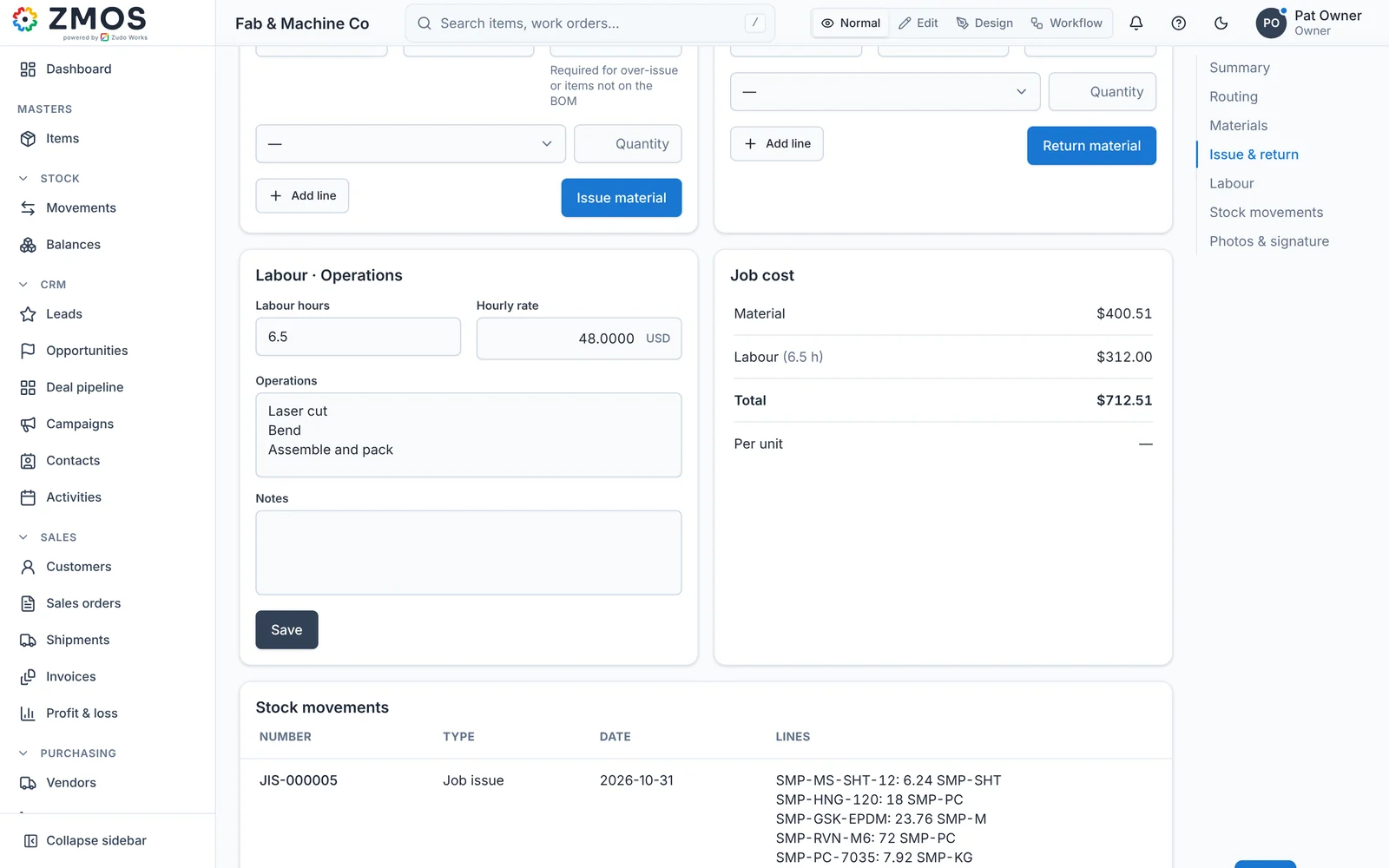
ZMOS is our own manufacturing software, built for sheet-metal, machining and fabrication shops of 10 to 50 people. It is organised around the job rather than the stock item. You open a job, print a job card with a barcode, issue material to it and log labour hours, and the job page shows the running cost: material issued less returns, plus labour at your hourly rate. Stock, purchasing, quality records, sales, CRM and double-entry accounts sit in the same workspace.
It is sold per bundle of three seats, with a six-month free trial for startups and registered partners. Prices are published in rupees on the ZMOS pricing page.
Where Unleashed and Katana are the better choice. Most readers of this comparison should not choose ZMOS, for these reasons:
- Traceability. ZMOS does not track batches or serial numbers. Both of the others do. A food, drink, cosmetics or supplement maker should not choose ZMOS.
- Selling channels. ZMOS has no ready-made Shopify, Xero or MYOB connector. It has an API, webhooks and CSV import and export instead.
- Planning. ZMOS has no MRP run from a forecast. Unleashed offers forecasting and MRP in Advanced Inventory Manager, and Katana plans materials per order.
- Bills of materials. A ZMOS BOM is single-level, with revisions. Both others handle multi-level BOMs.
- Track record. ZMOS is new in 2026. Unleashed has been sold since 2009.
ZMOS fits a small job shop that wants actual job cost without a long project. Our page comparing ZMOS with MRPeasy, Katana and TranZact sets them side by side.
Checklist: before you sign up for either
- Count your SKUs. Raw materials, packaging, components and finished goods. More than 30 means Katana’s paid plan.
- Count users and monthly sales orders. Those set the size of an Unleashed package.
- List the modules you need. Production, forecasting, bins, B2B store, CRM. Check which Unleashed package includes each one.
- Run a mock recall in the trial. One raw material batch forward to every customer.
- Build one real product. Your own BOM, your own steps, one purchase and one delivery.
- Confirm the accounts link. Xero, QuickBooks Online or MYOB, and how GST codes come across.
- Ask for the quote in your currency. Ask whether GST is added and what onboarding costs.
Plan the changeover as well as the choice. Our guide to the implementation timeline shows what the weeks after signing usually hold.
What to take from this
Unleashed and Katana are both good answers, to different questions. Unleashed answers “how do I keep stock and orders right across warehouses, channels and trade customers, and assemble what I sell”. Katana answers “how do I get products through my workshop and know what each build cost”. Work out which question is yours, then read both pricing pages with your own counts of users, orders and SKUs.
If neither fits because your process is unusual, we build manufacturing systems to order. See custom software development, or try ZMOS on the free trial if you run a small job shop.
Watch and share
The same guide as a short video, on the channels where we post it. Share the one that suits the person you are sending it to.
- YouTube: the 50-second video
- YouTube Shorts: the vertical version
- Instagram: the Reel
- Facebook: the Reel
- LinkedIn: Zudo Works page
- LinkedIn: Arunkumar V
- Instagram: the four-slide guide
- Facebook: the four-slide guide
- LinkedIn: Zudo Works page, four slides
- LinkedIn: Arunkumar V, four slides
- Threads: the short version
- Mastodon: the short version
Frequently asked questions
Frequently asked questions
Is Unleashed better than Katana for manufacturing?
It depends on the work. Unleashed is inventory software with production as a module, strongest on stock, wholesale and multi-channel orders. Katana puts production nearer the centre, with routings, a Shop Floor App and make-to-order work. Unleashed's own comparison page says its scheduling is less focused on complex multi-stage workflows than Katana's.
Does Unleashed include manufacturing on every plan?
No. Unleashed's help centre says bills of materials, assemblies and disassemblies are not supported on the Lite package. The Production and Manufacturing module is included on Pro and is an optional add-on with Core, according to the pricing page read on 26 November 2026.
Does Katana have a free plan?
Yes. Katana's pricing page lists a Free plan with no card, up to 30 SKUs, all features within that limit, unlimited users, integrations and inventory locations, and API access. For the first 15 days you can work with unlimited SKUs. Shopify is the only e-commerce integration on Free.
Do Unleashed and Katana integrate with MYOB?
Neither has a native MYOB integration on the pages we read. The MYOB app marketplace lists a third-party app, Unleashed Sync by WBSync, that syncs Unleashed with MYOB AccountRight. Katana lists only QuickBooks Online and Xero for accounting, though on its Advantage plan Katana's engineers build custom integrations.
Is Unleashed an Australian or New Zealand company?
Unleashed was founded in Auckland, New Zealand, in 2009 and opened offices in Australia and the United Kingdom. It was acquired by the UK-based Access Group in November 2020. It invoices in NZD, AUD, USD or GBP.
Is Katana priced per user?
No. Katana's pricing FAQ says every Advantage plan includes unlimited users, and the Free plan also allows unlimited users. Unleashed packages include a set number of user licences, and further users are bought as extras.