

A customer rarely remembers the nine deliveries that arrived as promised. They remember the one that came three days late, or the one that turned up with 40 brackets when the order said 50. DIFOT puts a number on that experience. It asks one question of every delivery: did the customer get everything they ordered, when they were told they would get it.
This guide is written for manufacturers of roughly 10 to 50 people in Australia and New Zealand who have been asked for a DIFOT figure by a customer, or who want one for themselves. It covers what the term means, the formula, a worked example, how DIFOT differs from OTIF and on-time delivery, and the rules you have to settle before the figure can be trusted. Outside sources were checked on 21 November 2026 and are linked where they are used.
The short answer
- DIFOT stands for delivery in full, on time. A delivery passes only if the full quantity arrives on or before the agreed date. Late, short or both is a failure.
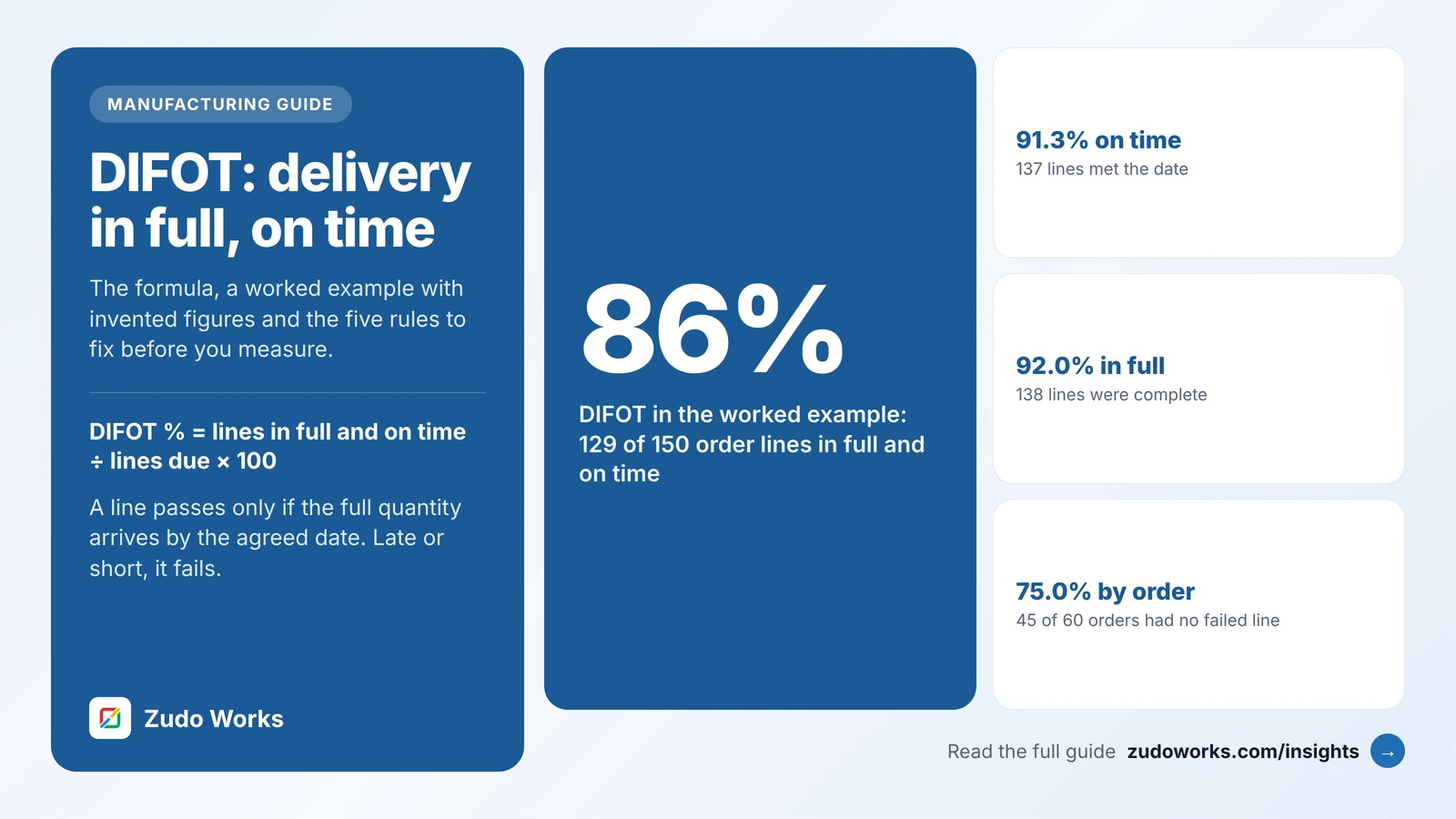
- The formula: DIFOT % = deliveries in full and on time ÷ deliveries due × 100.
- Count by order line. It is the fairest unit for a manufacturer, because one order can hold a simple stocked part and a complex made-to-order one.
- Measure against a date the customer saw. Use the first date you promised, or the date they asked for. A date you moved yourself does not count.
- Write the rules down first. Unit, date, ship or receipt, the tolerance limits and split deliveries. The same month can score 75 or 86 per cent depending on those choices.
- There is no universal target. Your customer’s supply agreement sets the number that matters.
What DIFOT means
DIFOT has two tests, and a delivery must pass both.
In full means the quantity delivered matches the quantity ordered, of the right item, in a condition the customer accepts. Forty brackets against an order for 50 is a failure even if they arrive a day early.
On time means the delivery met the agreed date. Which date that is, and whether it means the day the goods left you or the day they arrived, is a choice covered below.
The term is regional. Google Trends for the past 12 months, checked on 21 November 2026, shows search interest in the word DIFOT concentrated in New Zealand and Australia, with the United Kingdom and the United States close to zero. Buyers elsewhere usually say OTIF for much the same thing. Australia Post, for example, publishes an explainer for small businesses that describes DIFOT as a metric used to check how the final steps in a supply chain are performing. So if an Australian or New Zealand customer sends you a supplier scorecard, DIFOT is the word you are likely to see on it.
The DIFOT formula
In words: take every delivery that was due in the period, count how many arrived in full and on time, divide by the number due and multiply by 100.
DIFOT % = deliveries in full and on time ÷ deliveries due × 100
Two points make the formula honest. First, the bottom line is what was due in the period, not what was shipped. An order that should have gone in March and is still on the floor in April is a March failure, and leaving it out flatters the score. Second, a delivery has to pass both tests at once. You cannot multiply your on-time rate by your in-full rate and call the result DIFOT, because some deliveries fail both tests and would be counted twice. The worked example shows the difference.
A worked example
The figures below are invented to show the arithmetic. A fabrication shop had 60 customer orders due in October, with 150 order lines between them.
| What happened to the line | Lines | Counts as |
|---|---|---|
| Full quantity, on or before the promised date | 129 | Pass |
| Full quantity, but late | 9 | Fail (on time) |
| On the date, but short | 8 | Fail (in full) |
| Late and short | 4 | Fail (both) |
| Total due | 150 |
DIFOT by line = 129 ÷ 150 × 100 = 86.0 per cent.
Now look at the two halves on their own. Lines that met the date: 129 + 8 = 137, so on-time delivery is 137 ÷ 150 = 91.3 per cent. Lines that were complete: 129 + 9 = 138, so in-full is 138 ÷ 150 = 92.0 per cent. Both look healthier than 86. Multiply them together and you get 84.0 per cent, which is wrong in the other direction, because the four lines that were late and short have been counted against the shop twice.
DIFOT by order is stricter. Suppose the 21 failed lines were spread across 15 orders. Only 45 of the 60 orders had every line pass, so DIFOT by order is 45 ÷ 60 = 75.0 per cent. Same month, same deliveries, eleven points lower.
The date matters as much as the unit. Suppose 12 of the 129 passing lines met the date the shop promised, but that date was later than the one the customer first asked for. Measured against the requested date, only 117 lines pass and DIFOT falls to 78.0 per cent. None of these four figures is wrong. They answer different questions, which is why the rules need to be agreed before anyone quotes a number.
DIFOT, OTIF and on-time delivery
The three terms overlap, and people use them loosely.
| Term | Stands for | What it tests |
|---|---|---|
| DIFOT | Delivery in full, on time | Quantity and date together. The usual term in Australia and New Zealand. |
| OTIF | On time, in full | The same two tests. The usual term in the United Kingdom, Europe and North America, and on many large retailers’ scorecards. |
| OTD | On-time delivery | The date only. A short delivery that arrives on the day still passes. |
| DIFOTAI | Delivery in full, on time, accurately invoiced | Adds a third test: the invoice matched the order and the delivery. |
Wikipedia’s entry on DIFOT treats DIFOT and OTIF as one measure and gives a single formula for both. Some vendors draw a line between them. Mecalux, a warehouse equipment maker, suggests that the choice of term varies by industry or region, and that DIFOT may lean towards the supplier’s own shipping standard while OTIF looks at receipt from the customer’s side. There is no standards body behind either word, so do not rely on the label. If a customer asks for DIFOT or OTIF, ask for their written definition and measure to that.
On-time delivery on its own is still worth tracking, and our short answer on how to measure on-time delivery covers it. It is the easier figure to start with. DIFOT is the one that matches what the customer experienced.
Five rules to agree before you measure
These are the choices that moved the worked example from 75 to 86 per cent. Settle them once, write them at the top of the report and do not change them from month to month.
| Rule | The options | A sensible default for a small manufacturer |
|---|---|---|
| 1. Unit | Whole order, order line, or units and cases | Order line. It is the level the Wikipedia entry names alongside orders, and the level the Infor example below works at. |
| 2. Date | Date the customer requested, date you first promised, or the latest revised date | The first promised date. If the customer asks for a change, record that and use the new date. If you moved it, the old date stands. |
| 3. Ship or receipt | The day goods left your dock, or the day they reached the customer | Receipt, if you arrange the freight. Ship date, if the customer collects or books their own carrier. |
| 4. Limits | Exact day, a window of days, early deliveries allowed or not, small over or under quantities allowed or not | On or before the date, exact quantity, unless the customer’s terms say otherwise. |
| 5. Splits | Each part judged alone, or the line judged when the last part arrives | The line fails if you split it. If the customer asked for the split, judge each scheduled delivery as its own line. |
Each default has a published precedent. The Wikipedia entry says the time is the one expected by the customer, in many cases with a tolerance defined with them, and that where an order is split at the customer’s request each delivery line is considered. It also reports research finding that suppliers who met OTIF against their own promised date often failed the same test against the date the customer requested, which is the gap shown in the worked example.
Software makes these choices too, and not always the way you would. Infor’s help for CloudSuite Industrial, an ERP system, describes its DIFOT check as two questions on each customer order line: was the order fulfilled with the correct number of items, and was it shipped on the correct date. It has separate settings for early and late shipments and for surpluses and deficits. That is a ship-date rule with a tolerance for early and over-quantity deliveries. If your system reports DIFOT, read how it decides before you send the figure to a customer.
Early deliveries deserve a thought. A customer running a tight store may count a pallet that arrives a week early as a failure, because they have nowhere to put it. Over-deliveries are similar. Ask.
What is a good DIFOT score?
There is no universal benchmark, and the figures quoted online should be read with care. Vendor guides commonly state that 95 per cent or more is the mark of a leader. Mecalux says the metric should ideally be close to 100 per cent. ShipBob’s guide for online retailers gives 95 per cent and a set of targets by product type. Neither page cites a study for its figures. The one sourced figure we found is in the Wikipedia entry, which cites a 2009 paper by Godsell and van Hoek for leading practice in United Kingdom retail of more than 97 per cent, measured for each stock-keeping unit.
That retail figure describes supermarkets taking stocked goods from large suppliers. A shop making parts to order with outside processing is in a different position, and a figure measured by order will always be lower than the same deliveries measured by line. Three things are more useful than a borrowed target:
- The customer’s number. If a supply agreement or scorecard sets a DIFOT level, that is your target, measured their way.
- Your own trend. Twelve months of your own figure, measured the same way each month, tells you more than any industry average.
- Lead time beside it. A shop can reach a high DIFOT by promising eight weeks when customers want three. Report the average promised lead time next to the score so that one cannot be bought with the other. Our guide to reducing manufacturing lead time covers that side.
How to start measuring DIFOT
You need four facts for every order line: the date promised, the quantity ordered, the date delivered and the quantity delivered. Most small shops already hold these somewhere, often split between the order book, the delivery dockets and the accounts package.
- Write down the five rules above and have the person who deals with your biggest customer agree them.
- Record the first promised date on every order line when the order is accepted, in a field that is not overwritten when the date moves.
- Record a second field for any revised date, with who asked for the change: the customer or the shop.
- Record the delivery date and the quantity on each line when the goods leave, from the delivery docket or the proof of delivery.
- At month end, list every line that was due in the month, including lines still not delivered, and mark each one pass or fail.
- Give every failed line one cause from a short fixed list.
- Publish the percentage with the list of failed lines beside it, and review both each week.
A spreadsheet is enough to begin. One row per order line, columns for the four facts, a pass or fail column and a cause column. The weakness of a spreadsheet is the second point in the list: nothing stops someone typing over the promised date, and once that happens the history is gone. A system that keeps an audit trail of changes closes that gap.
Why deliveries fail, and what to fix first
A DIFOT percentage tells you how often you failed. The cause codes tell you what to do about it. Keep the list short enough that people use it:
- Material shortage. A purchased part or raw material was not there when the job needed it. See how to reduce material shortages and our guide to purchasing and reorder points.
- Capacity. The work centre was booked with other jobs. Production planning for small manufacturers covers loading work against real capacity.
- Quality. Rework or scrap delayed the job or cut the quantity. A short delivery after a failed inspection belongs here, and should also raise a record in your NCR and CAPA process.
- The promise. The date was not realistic when the order was taken. This is a quoting problem, not a production one. Our guide to quoting software for manufacturing explains how a quote should arrive at a date.
- Outside processing. A plater, powder coater or heat treater returned the work late.
- Freight. The goods left on time and the carrier delivered late. This cause only exists if you measure at receipt.
- Customer change. The customer changed the order after it was accepted. If a new date was agreed, the line is judged against it.
After two or three months one or two causes will account for most failures. Fix those. In many small shops the first is the promise itself: dates are given from habit instead of from the current load, and no amount of effort on the floor can recover a date that was never achievable.
DIFOT belongs on the same page as a handful of other figures, each of which explains part of it. Our guide to manufacturing dashboards and KPIs shows how they fit together.
Where ZMOS fits, and where it does not
ZMOS is our manufacturing system for shops of 10 to 50 people. This section describes only what is built, checked on 21 November 2026.
A quote in ZMOS carries a due date, and confirming it creates the sales order. Work orders move through statuses, and every change is written to an audit log, so a date cannot be altered without a record of who did it and when. Using the low-code tools, a shop can add its own fields to any form, such as a first promised date, a revised date and a cause code, and attach workflow rules to status changes. Zudo AI answers from the workspace data within the user’s role and can calculate from it. Its formula library includes on-time delivery, defined as on-time orders divided by total orders, and it can propose a chart, which a person approves before it is saved.
What ZMOS does not have is a ready-made DIFOT report built to a retailer’s standard, a link to carriers for proof of delivery, or a feed into a customer’s supplier portal. If you need those, check the scope in a demonstration first, or ask us about custom software. We also build on Zoho, and a delivery scorecard in Zoho Creator is a common small project. Startups and registered partners can try ZMOS free for six months.
What to take from this
DIFOT is a simple sum resting on five decisions. Decide the unit, the date, ship or receipt, the tolerance and how part deliveries count. Measure every line that was due, not only the ones that shipped. Record a cause for every failure, and report the promised lead time beside the score. Then the number is one you can defend to a customer and act on inside the shop. If you supply customers in Australia or New Zealand, expect to be asked for it.
Watch and share
The same guide as a short video, on the channels where we post it. Share the one that suits the person you are sending it to.
- YouTube: the 50-second video
- YouTube Shorts: the vertical version
- Instagram: the Reel
- Facebook: the Reel
- LinkedIn: Zudo Works page
- LinkedIn: Arunkumar V
- Instagram: the four-slide guide
- Facebook: the four-slide guide
- LinkedIn: Zudo Works page, four slides
- LinkedIn: Arunkumar V, four slides
- Threads: the short version
- Mastodon: the short version
Frequently asked questions
Frequently asked questions
What does DIFOT stand for?
DIFOT stands for delivery in full, on time. It is the percentage of deliveries that arrived with the full quantity ordered on or before the agreed date. A delivery that is late, short or both counts as a failure. The term is used mainly in Australia and New Zealand; buyers elsewhere usually say OTIF.
How do you calculate DIFOT?
Divide the number of deliveries that were both in full and on time by the number of deliveries due in the period, then multiply by 100. Count everything that was due, including orders not yet delivered. Do not multiply an on-time rate by an in-full rate: deliveries that fail both tests would be counted twice.
What is the difference between DIFOT and OTIF?
In practice they measure the same thing: whether the full quantity arrived by the agreed date. OTIF, on time in full, is the usual term in the United Kingdom, Europe and North America. No standards body defines either term, so ask the customer for their written definition and measure to that.
What is a good DIFOT percentage?
There is no universal benchmark. Figures such as 95 per cent appear on many vendor pages without a source. The target that matters is the one in your customer’s supply agreement, measured their way. Beside it, track your own trend month by month and the average lead time you promise.
Should DIFOT be measured by order or by order line?
By order line for most manufacturers. Measuring by whole order is stricter, because one short line fails the entire order, and it hides which products cause the trouble. Whichever unit you choose, state it on the report and keep it the same every month so the trend can be trusted.
Is DIFOT measured on the ship date or the delivery date?
Either, as long as it is agreed. The customer experiences the day the goods arrive, so receipt is the better test when you arrange the freight. If the customer collects or books the carrier, the ship date is fairer. Some ERP systems judge on ship date by default, so check how yours decides.