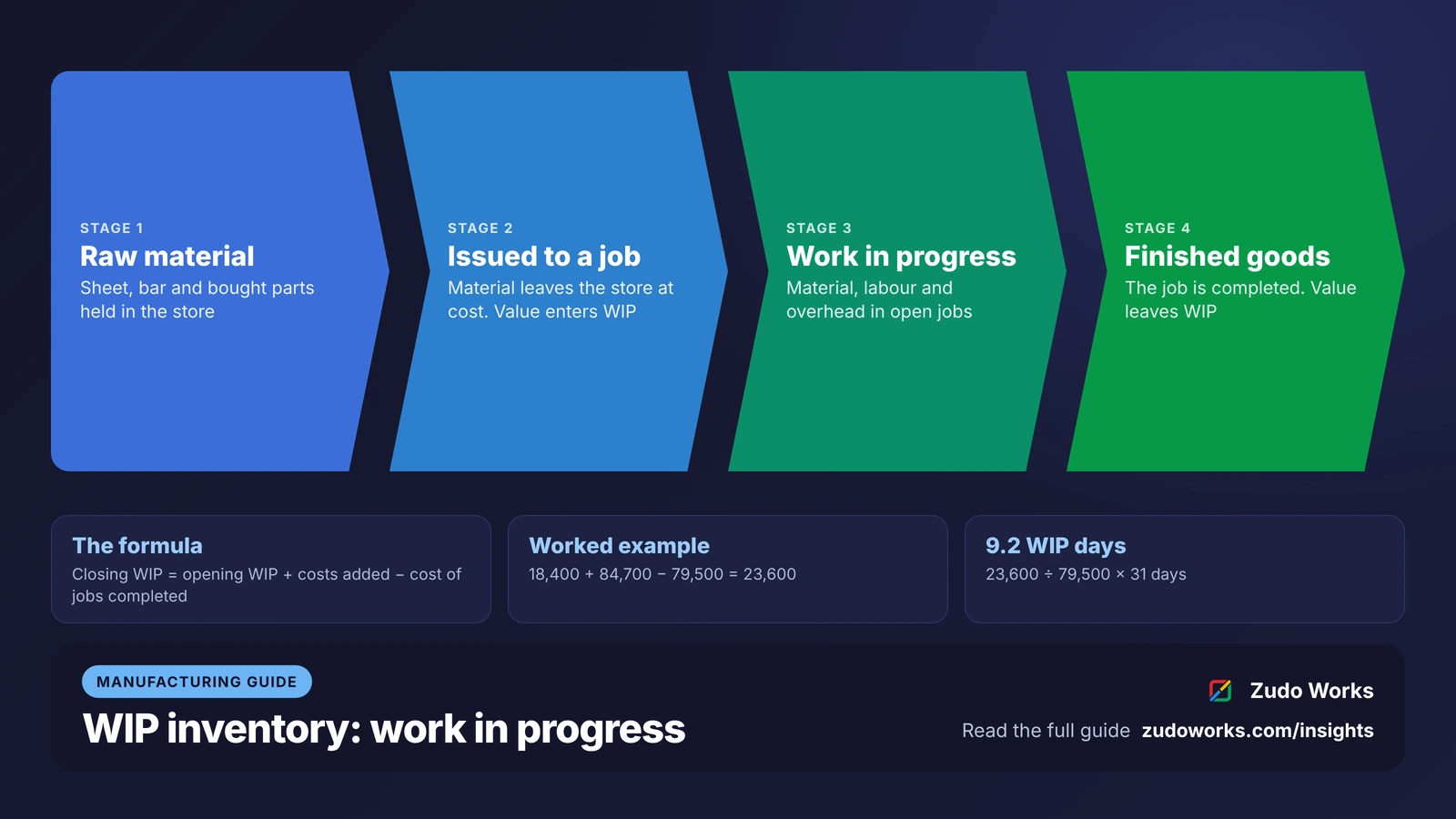

A storekeeper issues 150 steel sheets to a job. Some came in last month at one price and some this week at a higher one. What did those 150 sheets cost? The answer depends on the costing method, and it flows straight into the job cost, the margin on the order and the stock value your accountant reports at the year end. Pick the method by accident, or change it halfway through a year, and job costs stop being comparable.
This guide is for owners, production managers and finance staff in manufacturers of roughly 10 to 200 people, mainly in the United States, the United Kingdom, Australia and New Zealand. It explains first-in, first-out (FIFO), weighted average (periodic and moving) and standard cost, works one month through all of them, sets out what the accounting and tax rules in each country allow, and ends with a way to choose. The rules and vendor pages were checked on 28 November 2026 and are linked where they are used. This is general information, not accounting or tax advice: agree the method with your accountant.
The short answer
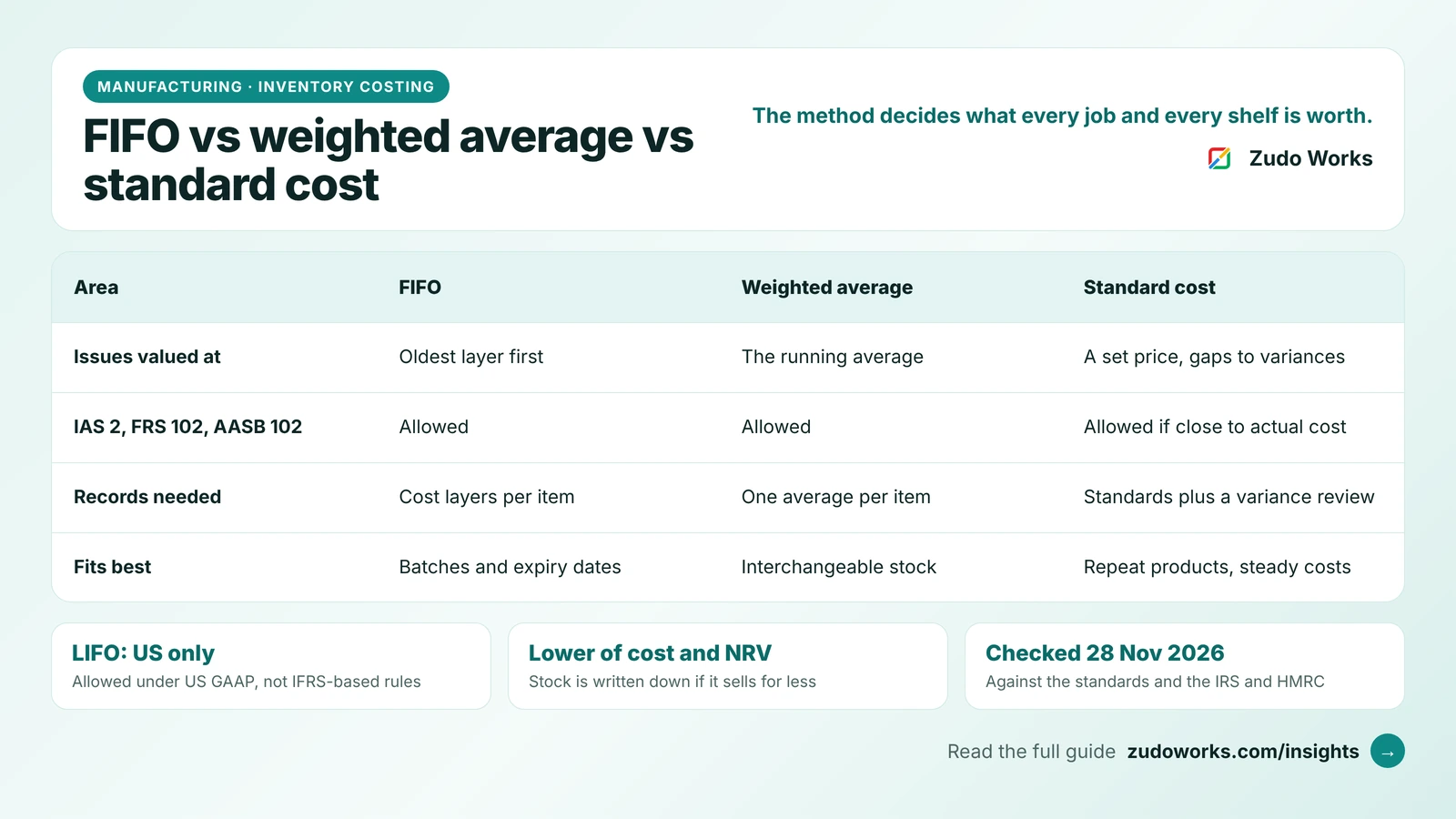
- FIFO assumes the oldest stock is used first. Jobs carry older prices; the stock left on the shelf carries the newest ones.
- Weighted average spreads the cost of everything you hold evenly. A periodic average is worked out once a month or year; a moving average is recalculated each time stock comes in, which is what most inventory and manufacturing software does.
- Standard cost uses a planned price set in advance. Actual costs that differ go to variances, which someone has to review and clear.
- IFRS-based rules (IAS 2, the UK’s FRS 102, Australia’s AASB 102, New Zealand’s NZ IAS 2) allow FIFO and weighted average, and standard cost only where it gives results close to actual cost. They do not allow LIFO.
- In the United States, US GAAP and the tax code also allow last-in, first-out (LIFO), with a conformity rule if you use it for tax.
- For most small manufacturers, a moving average is the simplest method that stays accurate. FIFO suits batch-tracked or perishable stock; standard cost suits repeat products with steady costs and someone to watch the variances.
Why the costing method matters in a factory
A retailer mostly feels the costing method in its gross margin. A manufacturer feels it in three places at once:
- Job cost. Material issued to a job is charged at the method’s cost. Two identical jobs a week apart can show different margins purely because of the method. Our guide to job costing explains the rest of the calculation.
- Work in progress and finished goods. The material in work in progress and in finished stock is valued by the same method, so it changes the balance sheet, not only the profit and loss.
- Quoting. If estimators price new work from last month’s job costs, the method shapes the next quote too.
The method never changes how much cash you paid suppliers. It changes when that cost shows up as cost of goods sold, and how much of it is still sitting in stock. In a month of steady prices the methods agree closely. When prices move, they part company, as the worked example shows.
The three methods explained
First-in, first-out (FIFO)
FIFO assumes the items bought or made first are used or sold first, so the stock left at the end of a period is the most recently bought. You keep each receipt as a cost layer (quantity and unit cost) and use them up oldest first. The IRS describes the method in exactly these terms in Publication 538.
FIFO does not mean you must physically pick the oldest stock, although for materials with a shelf life it is good practice to do so. It is a rule for assigning cost.
Weighted average: periodic and moving
Under weighted average, the cost of each item is the average of the cost of similar items held at the start of a period and those bought or made during it. Australia’s AASB 102, which follows IAS 2 word for word here, adds that the average may be calculated on a periodic basis or as each additional shipment is received (paragraph 27). Those are the two flavours:
- Periodic weighted average: total cost of opening stock plus receipts, divided by total units, once per period. Simple on paper, but job costs are not final until the period closes.
- Moving (perpetual) average: a new average is calculated at every receipt; every issue is costed at the average at that moment. Job costs are known the day material is issued.
Standard cost
A standard cost is a planned unit cost for each item, usually set once or twice a year from expected prices, normal scrap, labour and capacity. Stock and issues are valued at the standard. When you pay more or less, the difference goes to a purchase price variance; when a job uses more or less material or time than planned, the differences go to usage and efficiency variances.
The accounting standards treat standard cost as a measurement technique rather than a cost formula. Paragraph 21 of AASB 102 (the same as IAS 2) says it may be used for convenience if the results approximate cost, that standards should reflect normal levels of materials, labour, efficiency and capacity use, and that they must be regularly reviewed and revised in the light of current conditions.
A worked month: one material, four methods
Take one item, 2 mm steel sheet, in a small fabricator. The figures are invented to show the arithmetic and work in any currency.
| Date | Event | Sheets | Unit cost | Value |
|---|---|---|---|---|
| 1st | Opening stock | 100 | 40.00 | 4,000 |
| 5th | Receipt from supplier | 200 | 46.00 | 9,200 |
| 10th | Issue to job 101 | 150 | ||
| 18th | Receipt from supplier | 100 | 50.00 | 5,000 |
| 24th | Issue to job 102 | 120 | ||
| 31st | Closing stock | 130 |
Total cost available is 18,200 for 400 sheets. Every method must split that 18,200 between the 270 sheets issued and the 130 left, except standard cost, which also produces a variance.
FIFO
Job 101 takes the 100 oldest sheets at 40.00 and 50 of the next layer at 46.00: 4,000 + 2,300 = 6,300. Job 102 takes 120 more at 46.00: 5,520. Left: 30 at 46.00 and 100 at 50.00, so closing stock is 6,380.
Moving average
After the receipt on the 5th, 300 sheets are worth 13,200: an average of 44.00. Job 101 is charged 150 × 44.00 = 6,600, leaving 150 sheets worth 6,600. The receipt on the 18th brings 250 sheets worth 11,600: a new average of 46.40. Job 102 is charged 120 × 46.40 = 5,568. Closing stock is 130 × 46.40 = 6,032.
Periodic weighted average
At the month end, 18,200 ÷ 400 = 45.50 a sheet. Both jobs are charged at 45.50: 6,825 and 5,460. Closing stock is 130 × 45.50 = 5,915. Until the month closes, neither job has a final material cost.
Standard cost
Say the standard for the year is 45.00 and the opening stock was already carried at standard (so it stands at 4,500 rather than 4,000, and the totals below start from a different base). Both jobs are charged at 45.00: 6,750 and 5,400. Closing stock is 130 × 45.00 = 5,850. The two purchases cost more than standard: (46 − 45) × 200 + (50 − 45) × 100 = 700 adverse purchase price variance, which the accountant expenses or, if it is material, partly allocates back to stock.
The four results side by side
| Method | Job 101 (150) | Job 102 (120) | Total issued | Closing stock (130) |
|---|---|---|---|---|
| FIFO | 6,300 | 5,520 | 11,820 | 6,380 |
| Moving average | 6,600 | 5,568 | 12,168 | 6,032 |
| Periodic average | 6,825 | 5,460 | 12,285 | 5,915 |
| Standard cost (45.00) | 6,750 | 5,400 | 12,150 + 700 variance | 5,850 |
Three things stand out. With prices rising, FIFO gives the lowest cost of goods and the highest stock value, as the IRS notes in Publication 538. Job 101 costs anywhere from 6,300 to 6,825 for the same 150 sheets, a spread of more than 8 per cent before any labour is added. And the standard of 45.00 was already stale by the 18th; under paragraph 21 a standard that drifts from actual cost has to be revised, or the stock figure stops approximating cost.
What the rules allow in each country
Under every set of rules below, inventory is carried at the lower of cost and net realisable value: if stock can only be sold for less than it cost, it is written down. The costing method decides what “cost” is.
| Market | Accounting rules | Tax and other notes |
|---|---|---|
| United States | US GAAP allows FIFO, weighted average and LIFO. KPMG’s 2026 comparison of IFRS and US GAAP notes most companies use FIFO or weighted average, and some use LIFO for tax reasons. | The IRS accepts specific identification, FIFO and LIFO; LIFO is adopted with Form 970. Under section 472(c) of the tax code, a business using LIFO for tax must not use another method in reports to owners or for credit purposes. |
| United Kingdom | FRS 102 Section 13 allows FIFO and weighted average and does not permit LIFO. | HMRC’s manual accepts two bases, the lower of cost and net realisable value or mark to market, and says LIFO does not truly reflect profit for tax. |
| Australia | AASB 102 matches IAS 2: FIFO or weighted average for interchangeable items, standard cost if it approximates cost, no LIFO. | Use the same formula for all inventories of a similar nature and use (paragraph 25). |
| New Zealand | NZ IAS 2 follows IAS 2. The XRB lists a new version effective for periods beginning on or after 1 January 2027. | Inland Revenue expects the same cost-flow method for tax as in the financial statements; our WIP guide covers its trading stock rules. |
The IFRS Foundation’s summary of IAS 2 adds one more rule that matters to job shops: items that are not ordinarily interchangeable, such as a one-off machine built to a customer’s drawing, are costed by specific identification, using their own actual costs. In practice that is what job costing does for the finished job, while FIFO or average applies to the stock materials that go into it.
A note on LIFO
Last-in, first-out assumes the newest stock is used first, so cost of goods carries recent prices and the balance sheet carries old ones. When prices rise, it lowers taxable profit, which is why some US businesses use it. Outside the United States it is not an option under IFRS-based standards or FRS 102. In the US it brings extra work: cost layers or dollar-value pools, Form 970, and the conformity rule that ties your management and bank reporting to it. If your accountant recommends LIFO, ask how it will be reported to lenders and how your software will hold the layers before you agree.
Standard cost in practice: variances and when they help
Standard costing is more than a stock valuation. Its value is in the variances, which tell you where reality departed from the plan:
- Purchase price variance: paid more or less than standard. Points to suppliers, contracts and market moves.
- Material usage variance: a job used more or less material than its bill of materials said. Points to scrap, wrong BOMs or nesting.
- Labour rate and efficiency variances: paid a different rate, or took longer than the routing allowed.
- Overhead variances: production volume or spending differed from the budget used to set the overhead rate.
Standard cost works well in repetitive production with stable prices and an accountant or controller who reviews variances monthly. It works badly in a job shop where most work is one-off, prices move often and nobody owns the variance report. The standards go stale, the variances grow, and the stock figure drifts from actual cost. If you use standards, keep your bills of materials under revision control, because a usage variance is only as good as the BOM it compares against.
How to choose a method
| Your situation | Method that usually fits | Why |
|---|---|---|
| Job shop, many materials, a small finance team | Moving average | Job costs known when material is issued; one figure per item; no layers or variances to maintain |
| Batch or lot-tracked materials, expiry dates, food or chemicals | FIFO | Cost follows the physical flow you already manage; closing stock reflects recent prices |
| Repeat products, stable prices, a controller who reviews monthly | Standard cost | Fast, consistent product costing and variance reports that find waste |
| Small product range, costs checked only at the year end | Periodic weighted average | Simple to calculate by hand, but job costs wait for the period close |
| US business where tax deferral matters and prices are rising | Ask your CPA about LIFO | Lower taxable profit, at the price of conformity and record-keeping rules |
Whatever you pick, use the same method for inventories of a similar nature and use, apply it consistently from year to year, and agree any change with your accountant, because a change of method has its own accounting and, in the US, tax consequences.
What inventory and manufacturing software does
Most systems support one or two methods and some let you choose per item, so check before you buy rather than after. Two examples:
- Zoho Inventory, which we build on for clients, supports FIFO and Weighted Average Costing (moving average), assigned per item, with a FIFO Cost Lot Tracking report and a Weighted Average Costing Summary report, according to its inventory valuation reports help page. Our Fishbowl vs Zoho Inventory comparison covers the rest of the product, and Zoho Inventory vs Katana shows how Katana values stock.
- ZMOS, the manufacturing system we make, uses a moving average for every item. The next section shows how.
Questions worth asking any vendor: which methods are supported and can they differ per item; whether issues to jobs are costed at the moment of issue; how a finished job’s cost reaches finished goods stock; whether a posted movement can be edited (it should not be); and whether the stock valuation report reconciles to the ledger. Our Zoho ERP job costing guide walks through the same questions for Zoho.
How ZMOS values stock
ZMOS keeps one moving average cost per item, recalculated in the same step that posts each receipt. Everything else reads from that figure:
- Receipts need a unit cost. The item’s on-hand quantity and value are updated and a new average is worked out, exactly as in the moving average example above.
- Issues, job issues and transfers leave at the current average. When an issue empties an item, the whole remaining value goes with it, so no rounding residue is left behind.
- Finished parts from a completed job come into stock at the job’s actual unit cost: the material issued at moving average plus the labour logged on the job. See job costing in ZMOS.
- Posted movements cannot be edited, so the cost history cannot be rewritten; a correction is a new movement. Our explainer on the immutable stock ledger explains why that matters.
- The item’s current cost, the price you expect to pay next, is kept separately. It fills in purchase orders, quotes and BOM cost roll-ups and can follow the latest receipt price when you tick the box on the receipt.
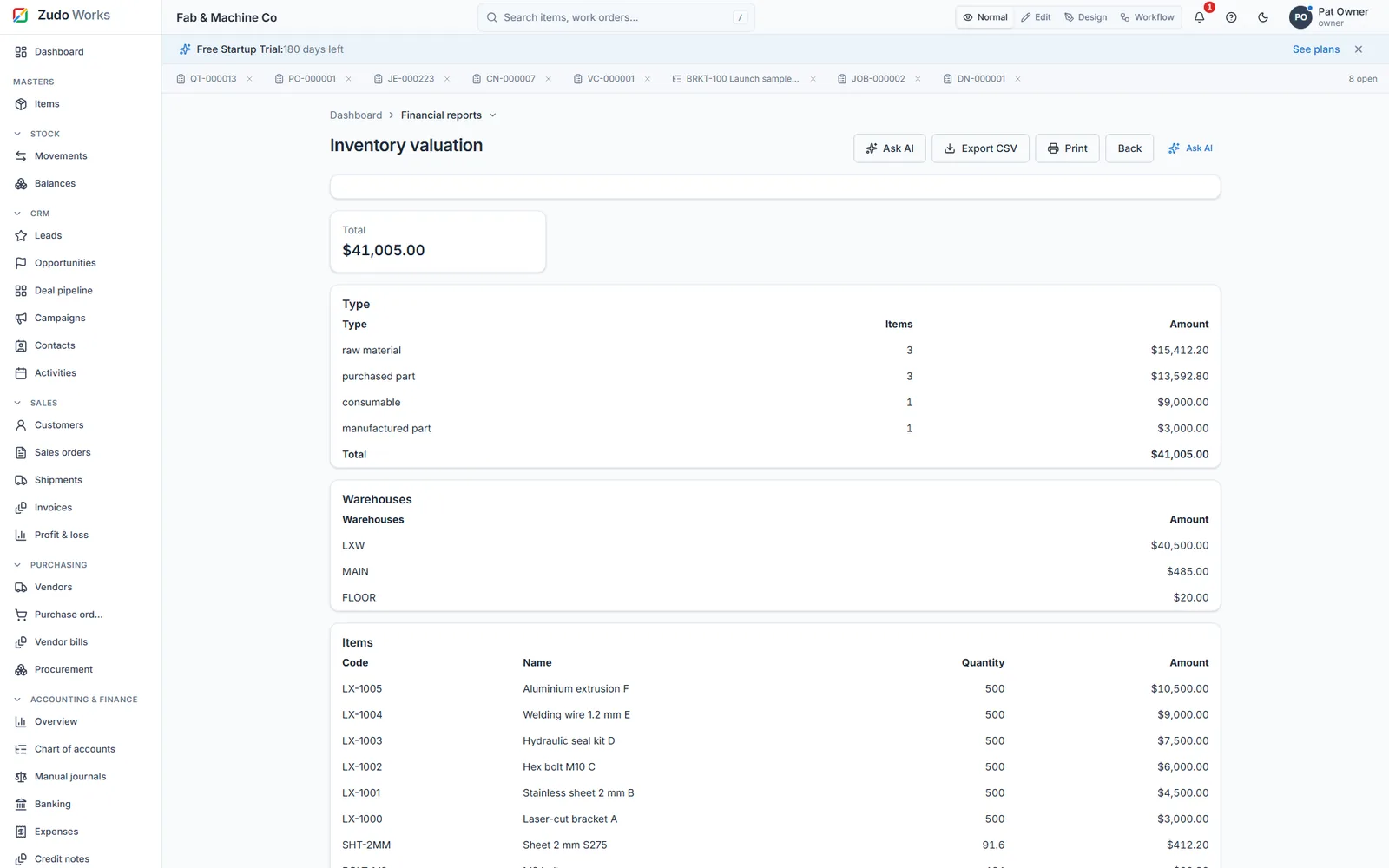
To be clear about the limits: ZMOS does not offer FIFO, LIFO or standard costing with variance accounts, and it does not absorb production overhead into job or stock cost. If your accountant needs FIFO layers, standard cost variances or overhead absorption for the statutory accounts, either choose a system built for that or plan for those adjustments at the period end. Read more on the ZMOS stock ledger page.
A checklist before you choose or change
- Ask your accountant which methods your reporting framework and tax position allow, and which they prefer.
- List your materials and mark which are batch or lot-tracked, perishable or one-off, since they may suit a different method.
- Decide who will own the numbers: someone must review variances (standard cost) or FIFO layers each month.
- Check that every receipt is posted with the real unit cost, including inbound freight and duty where your accountant includes them.
- Confirm your software costs issues to jobs at the moment of issue and posts finished jobs to stock at their actual cost.
- Run a cycle count on high-value items before switching, so the new method starts from correct quantities.
- Plan the change for a period start, record the opening values under the new method and keep a note of the change for the accounts.
If you want help setting up stock costing in Zoho or in a system built around your own process, our Zoho integrations and custom software teams can talk it through.
Frequently asked questions
Frequently asked questions
What is the difference between FIFO and weighted average cost?
FIFO charges the oldest purchase cost first, so stock on hand carries the most recent prices. Weighted average charges every unit at the average cost of all units held, recalculated each period or at every receipt. When prices are rising, FIFO gives a lower cost of goods sold and a higher stock value than weighted average.
What is the difference between moving average and standard cost?
A moving average follows actual purchase prices and is recalculated each time stock comes in, so there are no variances. Standard cost values stock and issues at a planned price fixed in advance, and records any difference from actual cost as a variance that someone must review and clear, usually monthly.
Which inventory costing method is best for a small manufacturer?
For most small job shops a moving average is the simplest accurate choice, because job costs are known when material is issued and there is one figure per item. FIFO suits batch-tracked or perishable materials, and standard cost suits repeat products with stable prices and a controller who reviews variances.
Is LIFO allowed in the UK, Australia or New Zealand?
No. FRS 102 in the UK, AASB 102 in Australia and NZ IAS 2 in New Zealand follow IAS 2, which allows FIFO and weighted average but not LIFO. HMRC also says LIFO does not truly reflect profit for tax. LIFO is available in the United States under US GAAP and the tax code.
Can I use standard cost under IFRS or FRS 102?
Yes, as a measurement technique, if the results approximate actual cost. Standards must reflect normal levels of materials, labour, efficiency and capacity use, and must be reviewed regularly and revised when conditions change. A standard that has drifted well away from actual prices no longer meets that test.
Can I change my inventory costing method?
Usually yes, but treat it as a formal decision with your accountant. The same method should apply to inventories of a similar nature and use and be applied consistently. A change affects comparisons between years and, in the United States, may need IRS consent through an accounting method change.